

Dr. Igor Siwanowicz’s photos offer us a fascinating insight into the world of the microcosm in all its detailed beauty. By training, Siwanowicz is a neurobiologist working at the Janelia Research Campus of the Howard Hughes Medical Institute, in Ashburn, Virginia (USA). His passion, however, is nature photography. He shows insects, plants or microorganisms, such as algae, in spectacular new ways, either macrophotographically or with the help of a laser confocal microscope. In his photos, microscopic structures become visible and are accompanied by a firework of colors. Siwanowicz has already won numerous prizes for his photos. In photonworld, he shows us some of his most beautiful images and tells us about his work.
"Photography is a great form of occupational therapy for me"
At eye level with his "models": nature photographer Dr. Igor Siwanowicz.
When did your passion for photography start?
Actually, I only started taking photos when digital technology became both affordable and was capable of delivering high quality images. I never had patience for film, or learning about techniques from books. Digital technology offers instant results and therefore an opportunity to make corrections on the go; the learning curve is very steep, and there is no cost associated with failures. Photography is a great form of occupational therapy for me because it grounds you in the moment when magic happens in five milliseconds.
What techniques do you use for taking your pictures?
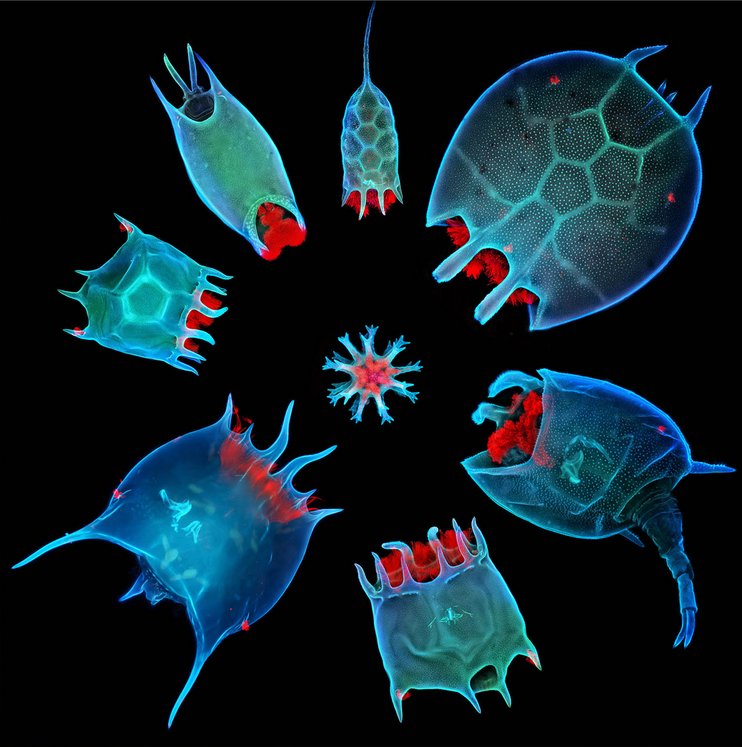
My photomicrographs are taken through a laser scanning confocal microscope, an imaging technique that uses lasers to scan three-dimensional samples. I first inject dyes into the neurons of interest. A laser then excites the dyes so that they emit light - it’s the same physical phenomenon that makes black light posters from the ’70s glow. The microscope that registers that light takes a series of images of the tiny specimen by scanning it point by point. Because the specimen is much thicker than the plane of focus, a series of images - called “stack” - is collected by moving the sample up or down. From those “optical slices” a three-dimensional image of the neurons within the sample can be reconstructed.
How much magnified do we see the insects?
II don’t use very high magnifications – most of the images in my collection are taken with a 10x objective, so the objects are magnified 100-fold. I also use 20x, 25x and 40x objectives giving magnification of 200, 250 and 400-fold. Some samples, due to their size, need be tiled – i.e. scanned multiple times as slightly overlapping stacks that are later merged, or stitched, together.
How do you edit your photos?
I consider image processing software such as Photoshop as much part of my workflow as the camera. I don’t manipulate or alter the subject matter, except some cases that are very obviously photoshopped, but I do tweak the global and local contrasts and the colour space until I’m satisfied with the result. In that sense, I’m definitely not a photography purist!
Ornaments of life are skillfully staged by Dr. Igor Siwanowicz.
Photographers play with light. Are there differences between the setting of light in macro- photography and conventional photography?
The lighting setup in macro photography is pretty much the same as in conventional photography. I’m using some variant of a three-point lighting, which in a classic studio setup consists of the key light, directed on the subject, a back light, also referred to as rim light, to get that brighter outline on one side of the subject, and a fill light, to soften the shadows and reduce harsh contrast. Also, a background light is often used to illuminate the backdrop behind the subject. Because macro photography is so much more compact, I can get away with using just two strobes to illuminate the scene: my back light often doubles as the background light, and if necessary I can also bounce it off a sheet of paper to mimic the fill light. I’m using an infrared flash transmitter to control the strobes mounted on individual light tripods. That allows me to move the light sources around and also to control the ratio of their output.
Diffusing the strobe light is essential, especially when shooting insects; their exoskeletons are often very glossy, and you don’t want to end up with over-exposed reflections. Softening can be accomplished by using relatively small softboxes. You attach them directly to the strobes. The whole setup – two flashes with their own tripods and diffusers plus a set of backdrops - fits easily inside a moderately sized backpack.
Recently I’m skewing towards using natural light; because its intensity is lower than that of the strobes, longer exposure times are needed so the subjects need to be rather stationary.
"Sonnenanbeterinnen sind mir bei weitem die liebsten Insekten"
How many pictures does it take until there is a perfect shot?
The success rate varies from session to session and model to model and oscillates between 1 and 100%. Luckily, when working in a digital medium there is no penalty or cost associated with taking any number of missed shots. I don’t know if I’d call those that pass the muster “perfect” though – some might be asymptotically approaching that ideal, but I have yet to take the perfect photo.
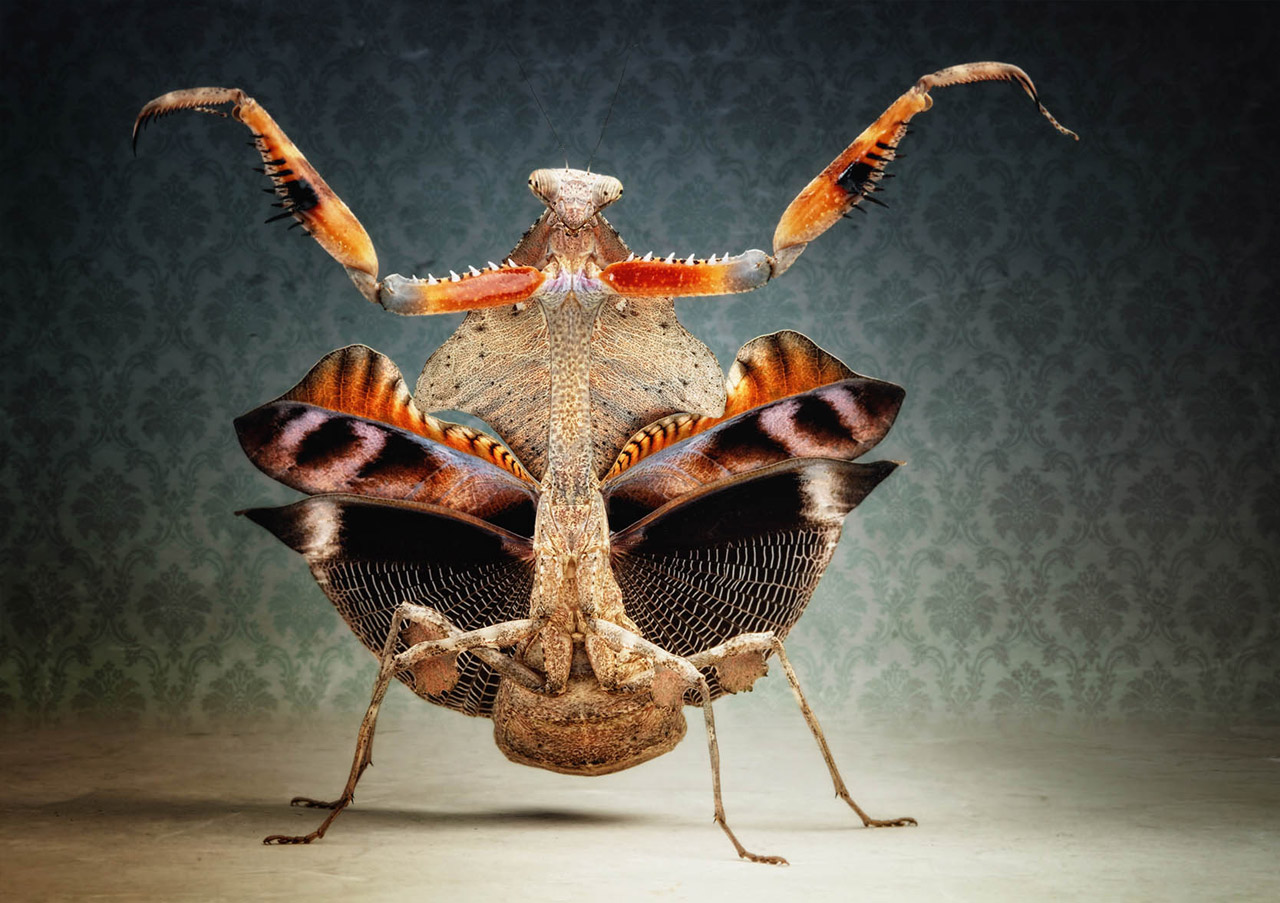
From nature into the living room:"The feedback I am often receiving indicates that I actually managed to convert some insect-phobic folks, apparently!"
Do you have a favourite motive, a plant or an animal, that you enjoy taking photos of most?
Praying mantises are by far my favourite insect models. They have certain unique qualities that set them apart from other insects and make them special. An ability to rotate the head, large, dome-shaped eyes sporting a pair of pseudo pupils (those dark spots that seem to follow you), grasping front legs used to manipulate the captured animals and in grooming, give them strangely anthropomorphic and at the same time otherworldly appearance. They come in all various shapes and colours; some may be disguised as a flower, a dry or fresh leaf or a twig. When their near-perfect camouflage fails and they are discovered by a bird or cat, mantises still have a plan B – a threatening display aimed at confusing the oppressor. The insects rise their brightly coloured front legs and wings, demonstrating contrasting patterns or eye spots, and seem to double in size. Those displays are when mantises really shine.
The combination of an alien-like appearance of a mantis with certain qualities of a fairy or a butterfly seems to cause cognitive dissonance in some viewers, and that is usually enough to capture their attention for a moment. The dramatic poses also seem to invoke many pop culture references (think ‘Time warp’, ‘Karate kid’ etc.); I think that makes it easier to relate to the insects in the photos. Bringing my “models” at the face-level with the viewer has also another effect – presented from their own perspective and taken away from the context of their natural environment, the animals acquire anthropomorphic qualities, personality and charm.
The feedback I am often receiving indicates that I actually managed to convert some insect-phobic folks, apparently! And then there are those that decided to ink some of my photos into their skin - it is an ultimate prize for every artist. Unfortunately, I’m not in touch with any of the individuals that chose to wear my images on their bodies.
My favourite plant “model” thus far was a humped bladderwort, which sounds like something from Harry Potter, but in fact is a carnivorous freshwater plant common in local ponds. Perhaps it is the perversion of the role reversal when a plant is devouring an animal that makes flesh-eating plants so interesting; I have been fascinated with carnivorous plants since early childhood – watching “Little Shop of Horrors'' might have something to do with igniting my fascination. The aquatic bladderwort was, at first glance, far less spectacular than, say, a Venus flytrap or a pitcher plant; it is able to tackle only minute prey like water fleas and copepods, so it wasn’t high on my Close Encounter wish list. Little did I know about the complexity the bladderwort’s trap reveals when magnified. In fact, it is considered the most sophisticated trapping organ in the plant kingdom, a true testimony to evolution’s ingenuity. Very often our consciousness translates the functionality of natural forms into beauty, and the trap is a good case in point.
Bladderworts are known to have an intimate relationship with single-cell green algae called desmids; the order Desmidiliaes comprises more than 8000 species worldwide, exhibiting a vast diversity of shapes and sizes. So, finding the bladderwort came with the bonus of stumbling upon those beautiful algae. I became immediately obsessed with them, a phenomenon known among microscopists as “desmid twitching” and characterized by the compulsion to take water samples from every pond I encountered.
Is there something special that you would like to photograph in the future?
The only thing that comes to my mind right now is a coconut crab… I would love to travel to some biodiversity hotspots, while they are still doing okay, such as Madagascar, Borneo, Costa Rica etc. Because of the pandemic those goals need to be put on hold, of course, and who knows for how long – I am not holding my breath. For now, I would be satisfied with visiting the American south again, I love the desert ecosystem and its inhabitants. I would like to meet the desert horned lizards on their own turf.