

Watches have long since ceased to be mere instruments for precise timekeeping. They are sometimes regarded as something special, as a criterion of distinction that underpins one's own habitus. They are sometimes regarded as something special, as a criterion of distinction that underpins one's own status and habitus. They are a fashion accessory, an expression of technical sophistication, a precious antique, or simply a status symbol whose value today can easily exceed the price of a limousine. Sometimes ostentatious, sometimes relying on understatement. That this has not only been the case since modern times is proven by an example from Roman antiquity: the horologium of Emperor Augustus. What does this have to do with light in the context of photonworld? Well, it is a kind of sundial.
In front of the Palazzo Montecitorio, today's seat of the Chamber of Deputies of the Italian Parliament, an imposing sight awaits the traveler to Rome: with a shaft length of almost 22 meters, an ancient Egyptian obelisk with hieroglyphic inscription has been rising into the sky here since 1792, and one may rightly ask what this object, which in the context of its installation seems to have fallen out of time and space, is all about. Historians and archaeologists can give an answer to the origin and history of this stone stele, which was rediscovered in Rome in five fragments only in the middle of the 18th century. The obelisk originally dates from the 6th century B.C. and was erected during the reign of Pharaoh Psammetich II in the Egyptian city of Heliopolis, an important center for the worship of Ra, the sun god.
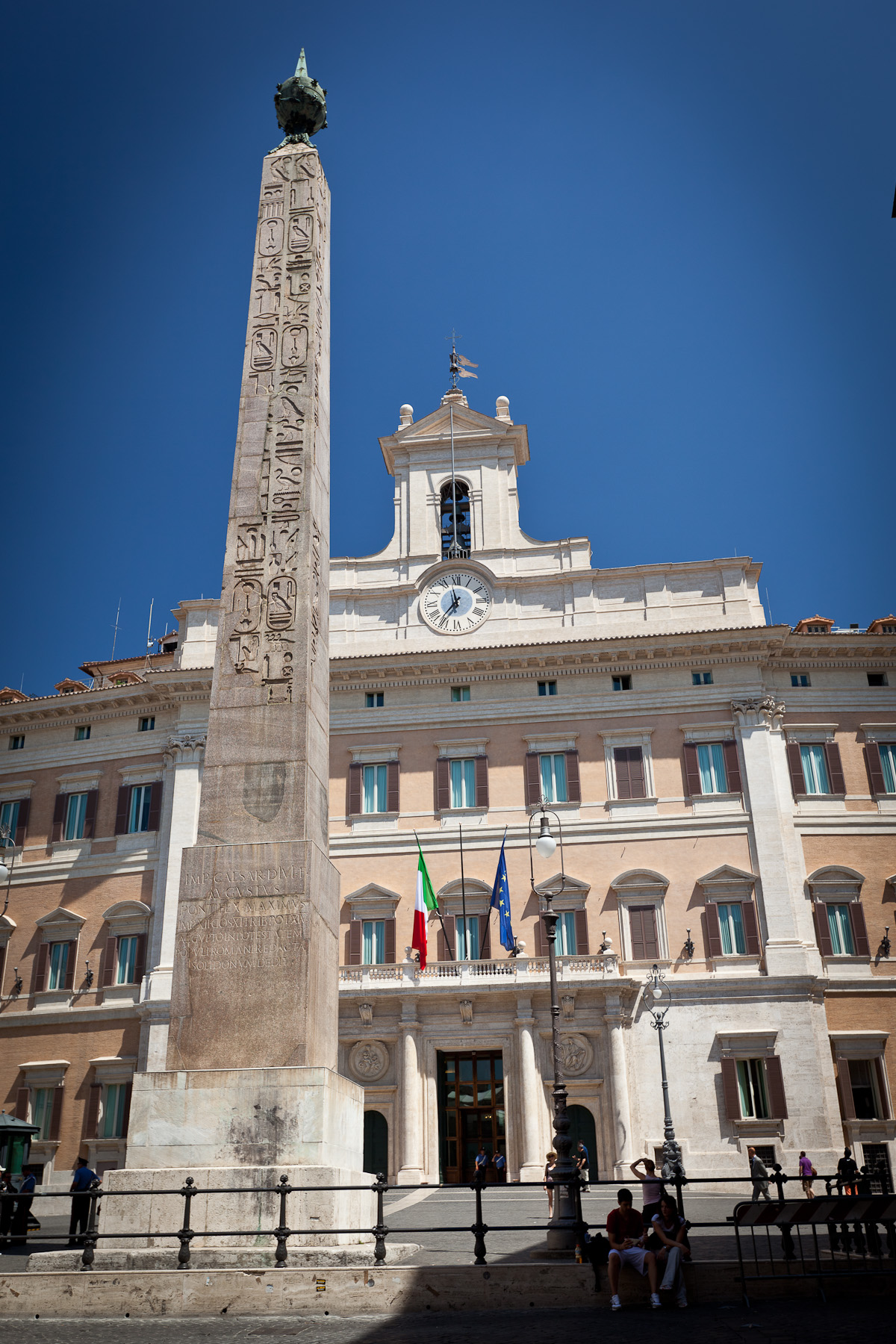
The obelisk of the Horologium Augusti has stood in front of the Palazzo di Montecitorio since 1792. (Photo: jimmyweee)
Obelisks are square monolithic stone pillars that taper toward the top and are crowned by a pyramidal finial. Ideologically, they are considered a manifestation of a ray of the divinely revered sun, thus creating an emblematic link between earth and the celestial realm. Their shadows, which change throughout the day, were metaphorically interpreted as the daily journey of the sun god on his barque from east to west. Thus, the obelisk, which reflects the unchanging course of the day and the seasons, is also a symbol of divine world order. With their phallic towering appearance, made of a single block of hard stone like granite, which defies weathering with an eternal claim and outlasts the times and thus made the hewing and breaking, the transport and the erection a sheer effort, they also embody the power and status of the respective ruler, who had them erected not entirely altruistically as a supposedly submissive votive gift in the sun sanctuaries.
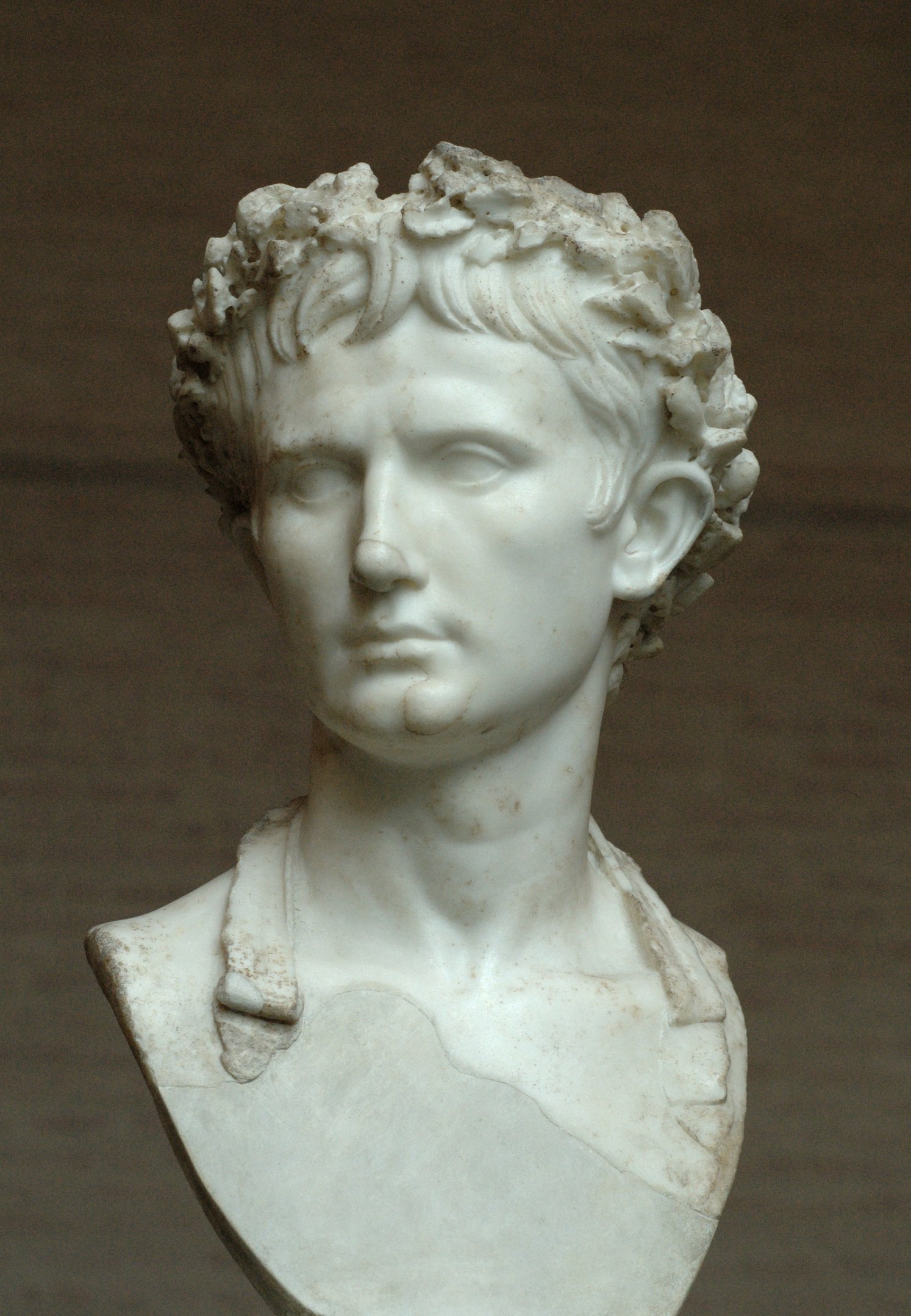
Augustus, 63 BC to 14 AD was the first emperor of the Roman Empire. Here his portrait from the Glyptothek in Munich.
Augustus, the first Roman emperor, who secured sole rule in the Roman Empire in 31 B.C. with his victory in the naval battle of Actium against Marcus Antonius and Cleopatra VII, had Psammetich II's obelisk transported to Rome in 10 B.C. as primus inter pares during his reign, where it was installed as part of a large-scale complex on a five-meter-high pedestal and crowned by a sphere almost 2,000 years before its current location on what was then the Campus Martius. From a purely functional point of view, it served there as a gnomon, a shadow-casting pointer, a form of sundial. The use and function of sundials are already documented for ancient Greece, whereby the Greeks, according to the historian Herodotus, had in turn adopted them from the Babylonians. For the Augustan system for measuring the course of time, a later description has been handed down by the Roman historian Pliny the Elder, who later became a victim of the eruption of Vesuvius around Pompeii in the year 79. after Christ. Thus, the latter reports that:
"Augustus used the obelisk on the Campus Martius in a remarkable way, namely to cast a shadow to mark the length of the days and nights. A paving was laid out, so adjusted to the height of the obelisk that the shadow of the obelisk touched the corner of the paving on the shortest day. The shorter and longer shadows were measured by bronze markings in the marble."(Pliny, Hist. nat., 36.72)
The installation known as Solarium or Horolgium Augusti was therefore a large-scale astronomical measuring station, which is also referred to as a meridian instrument or noon indicator and annual calendar. A horizontal meridian line made of bronze was inlaid into the ground plates of the Campus Martius. Modern research has shown that the noon shadow to be measured at the time of the winter solstice in Rome is about 65 meters from the obelisk. The meridian line marks the two solstice points, which are about 55 meters apart. Archaeological research has further confirmed that there were other bronze markings across the meridian line to divide it. Thus, the line was subdivided into the individual areas of the signs of the zodiac, which in turn have a 30° division for themselves. The shadow of the sphere of the obelisk thus showed the place of the wandering sun in the respective zodiac sign.
The exact information about it gave a spectacular excavation of the German Archaeological Institute at the beginning of the 1980s. In the run-up to the excavation, an attempt was made to reconstruct the location of the former site on the Campus Martius as accurately as possible. As a result, a spot excavation took place in the area now covered by housing complexes, during which the entire section of soil had to be iced in an elaborate procedure to prevent groundwater from penetrating. In an exposed area at a depth of about 6 meters under the cellar of a house in Via del Campo Marzio 48, the archaeologists actually came across a good 6.5 meter long section of the Augustan meridian line! The markings of the zodiac signs found there were inscribed in Greek, already the language of scholars at the time. On the western side the section runs from the zodiac sign of Aries ("Krios") at 19° to 16° Taurus ("Tauros"). On the east from 14° Leo ("Leon") to 11° Virgo ("Parthenos"). The distances of the degrees increase continuously from south to north from 19 to 30 cm. Since the site is located a good 1.5 meters above the Augustan ground level, it is assumed that the site was already destroyed during Roman antiquity and was reconstructed under the later emperor Domitian on the area that was now higher due to flooding of the Tiber.
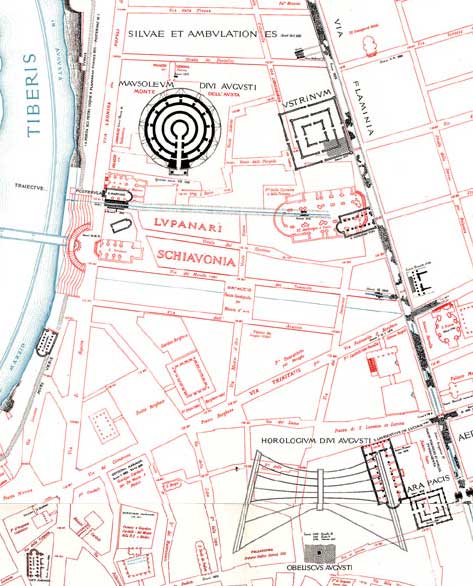
At the bottom right of the image, the map shows the original location of the Horologium Augusti and the Ara Pacis. (Source: Lanciani 1893-1901)
The Horologium of Augustus on the Campus Martius, which was originally located outside the gates of the ancient city of Rome, was embedded in an ensemble of interrelated representative buildings. In addition to the Mausoleum of Augustus, built during his lifetime, the complex referred to the original site of the Ara Pacis, the Altar of Peace of Augustus, which is now somewhat offset. The system of the whole complex, still discussed in research today, seems to have been so ingenious that on September 23, the birthday of Augustus, who was still born as Octavian and only received the honorary name of the "Exalted One" as emperor, the shadow moved exactly to the center of the visual axis of the peace altar in the course of this day, thus establishing a relationship between the propagated golden age characterized by peace and his princeps responsible for it.
The ancient installation on the Campus Martius, with its central element of the obelisk indicating the passage of time, which was transported from Heliopolis especially for this purpose, can be interpreted symbolically as a unique victory monument of Augustus triumphing over Egypt and his rival Marc Antonius: precisely a clock as a status symbol.