

When the first functional laser was developed in 1960, one had very little idea of the range of applications that such high-intensity beams of tightly collimated light would one day find. Today it is impossible to imagine today’s world without the laser. Lasers are now ubiquitous in consumer electronics, telecommunications, measuring devices, in industry, medicine and research. They have also become an indispensable tool in space research. And there is no sign that the laser will run out of useful things to do. Indeed, specialists believe that the 21st century is set to be the century of the photon, the smallest unit of light.
Theodore H. Maiman introduced the world’s first working laser to the press and the public in New York City on July 7, 1960. Reports in the newspapers next day were almost unanimous in viewing the new technology as the first practical realization of the deadly ray-guns that were a familiar feature of science fiction at the time. Indeed, the prescience displayed by the visionaries who first conceived the idea of concentrating light and described the properties and potential applications of tightly collimated light beams is quite astonishing. During the siege of Syracuse in Sicily in 212 BC, the Greek mathematician Archimedes is reported to have used mirrors made of bronze or glass to focus the Sun’s rays on Roman ships with the aim of setting them on fire. In his book New Atlantis, published in 1627, the English philosopher Francis Bacon prophetically wrote of a future society whose primary purpose was to acquire and exploit “knowledge of the causes and secret motions of things”. To this end, its rulers had set up what we would now call research establishments. These included ‘perspective houses’, in which “we represent also all multiplications of light, which we carry to great distance, and make so sharp as to discern small points and lines.”
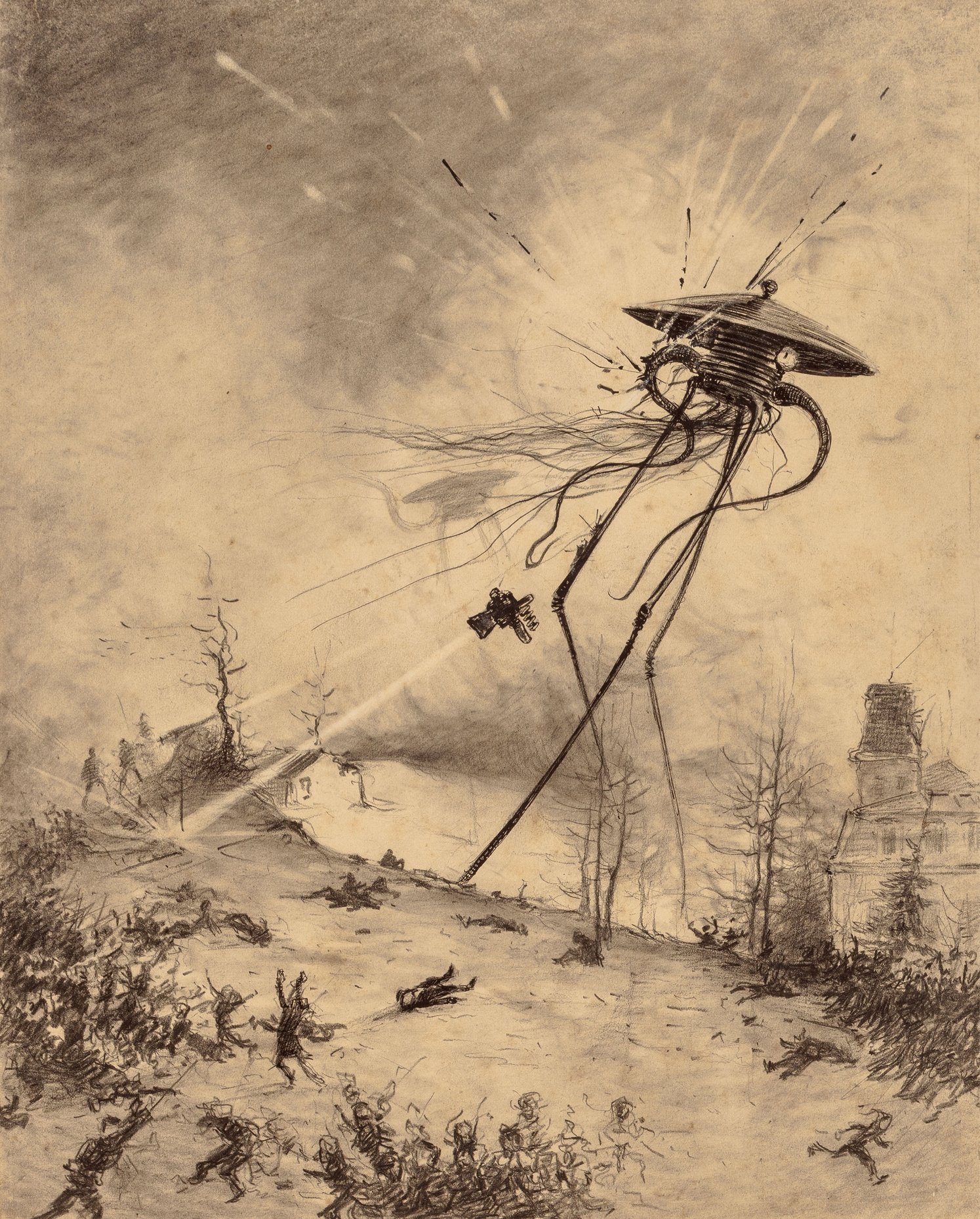
Illustration by Henrique Alvim Corrêa for H.G. Wells "The War of the Worlds" from 1898. Early on, Wells described the idea of an enormous heat-generating ray gun.
In the latter half of the 19th century, popular authors like Jules Verne and H.G. Wells wrote novels whose plots were based on highly imaginative projections of the technological developments of their time. Inspired by the scientific triumphs of their day, such as the discovery of X-rays and radioactivity, they ‘invented’ the literary genre of science fiction. In his 1898 novel The War of the Worlds, Wells developed the notion of a mobile weapon capable of generating and emitting an enormously powerful heat ray. In the book, invading Martians deploy these firearms to devastating effect after their landing on Earth. In a striking anticipation of miniaturization, this later became the hand-held ray-gun wielded by comic-book heroes like Buck Rodgers and Flash Gordon in the 1940s, which continues to make regular appearances in various guises on page and screen. The era of the Cold War and the development of the laser also saw the inception of manned spaceflight. This constellation in turn sparked ever more extravagant visions of extraterrestrial exploration (and mayhem!). Of these, the Star Trek and Star Wars series, with their plasma sabers, laser cannons and photon torpedoes, are undoubtedly the best known.
Lasers in Outer-Space
However most of what fans of these films get to see has remained in the realm of fiction, since many of the dramatic effects that they so enjoy have no basis in real science. In the vacuum of outer space, where scattering centers – such as dust particles – capable of refracting incident light are few and far between, laser ‘beams’ would be imperceptible. Owing to the paucity of oxygen, explosions would be equally unimpressive, and given the tenuous nature of the interplanetary medium, they could never furnish the deafening soundscapes that are a staple ingredient of both Star Trek and Star Wars in the cinema Here on Earth of course, the laser has become an indispensable part of our everyday lives. Every time we make a purchase in a supermarket a laser scans the barcode on the item at the checkout. Our bank cards and credit cards are embossed with holograms imprinted by lasers, and laser pointers have long replaced the wooden pointers some of us remember from our schooldays. In consumer electronics, communications and precision measurement technologies, in industry, medicine and research, lasers are now ubiquitous.
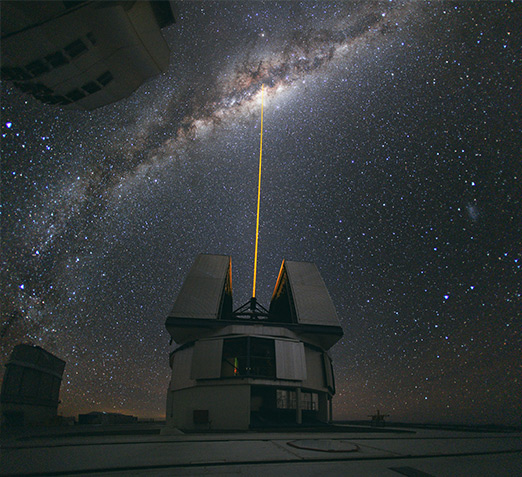
This artistic representation shows the Extremely Large Telescope in operation on the Cerro Armazones in northern Chile. The telescope uses laser beams to simulate fixed stars in the sky, which serve as orientation points for observing the real stars. Picture: ESO
And they have indeed found a range of applications in the realm first explored by the authors of science fiction – in space. To mention only one example, the European Southern Observatory’s Very Large Telescope (VLT), located in the Atacama Desert in Chile, uses laser beams to minimize errors in determining the precise positions of stars. The characteristic twinkling of stars is caused by turbulence in the atmosphere and limits the accuracy of astrometric observations. To combat this effect, a laser beam with precisely known properties can be projected on the night sky to serve as a calibration standard. Since the position of the laser spotlight is precisely known, the atmospherically induced distortions can be corrected for, yielding crisper, sharper images of the targets of interest.
The Century of Photonics
Given that the laser’s full potential as a tool has yet to be realized, the 21st century is set to become the century of photonics (named for the photon, or light quantum). For example, laser light – in the form of sequences of ultrashort light pulses is now elucidating the nature of quantum processes in ever greater detail, allowing researchers to characterize the incredibly fast dynamics of electrons within atoms.
Lasers have also become established in medicine, and current research trends include the quest for laser-based procedures for the early diagnosis and treatment of cancer. These efforts seek to exploit the ability of ultrashort laser pulses to identify the organic compounds (generally referred to as ‘metabolites’) present in samples of biological fluids. In principle, this makes it possible to generate a ‘molecular fingerprint’ that reflects the donor’s state of health – because the range of metabolites produced by healthy cells differs in certain ways from those synthesized in tumour cells, for example. Pulsed laser light interacts with the atoms in all these chemical compounds in highly specific ways such that particular frequencies are absorbed, depending on the structure of the molecule. Analysis of the transmitted spectrum therefore enables one to identify the molecular species that are present in a blood sample, and their concentrations. The method could one day enable doctors to detect cancers at very early stages, when they are relatively easy to treat successfully.
The Laser-based World of Tomorrow
The chances are that tomorrow’s computers will also benefit from the use of photons (instead of electrons) for the transmission of information – a transition that would enhance the efficiency of data processing enormously. Quantum computers promise a further boost in capacity and speed, because they are no longer dependent on binary ON/OFF switching elements as today’s computers are. Quantum processors exploit the laws of quantum physics and can operate not only on the binary bits 0 and 1, but on units of information known as qubits, each of which can encode several different quantum states simultaneously. Atoms, electrons and photons are all under investigation as potential qubits in future quantum computers. An optical quantum computer based on laser light would enable data to be transmitted with negligible losses, and would not need complicated arrangements for the dissipation of heat.
In the foreseeable future, autonomous vehicles will become a practical reality, partly because they can rely on laser technology to monitor their surroundings and react appropriately to other traffic. This breakthrough is largely due to developments in Light Detecting And Ranging (LIDAR). LIDAR systems are based on a laser that emits a stream of light pulses that impinge on, and are reflected by objects in the environment. By analyzing the intensity and travel times of the reflected pulses, a detector can then determine the sizes and distances of nearby obstacles, including pedestrians and other vehicles.
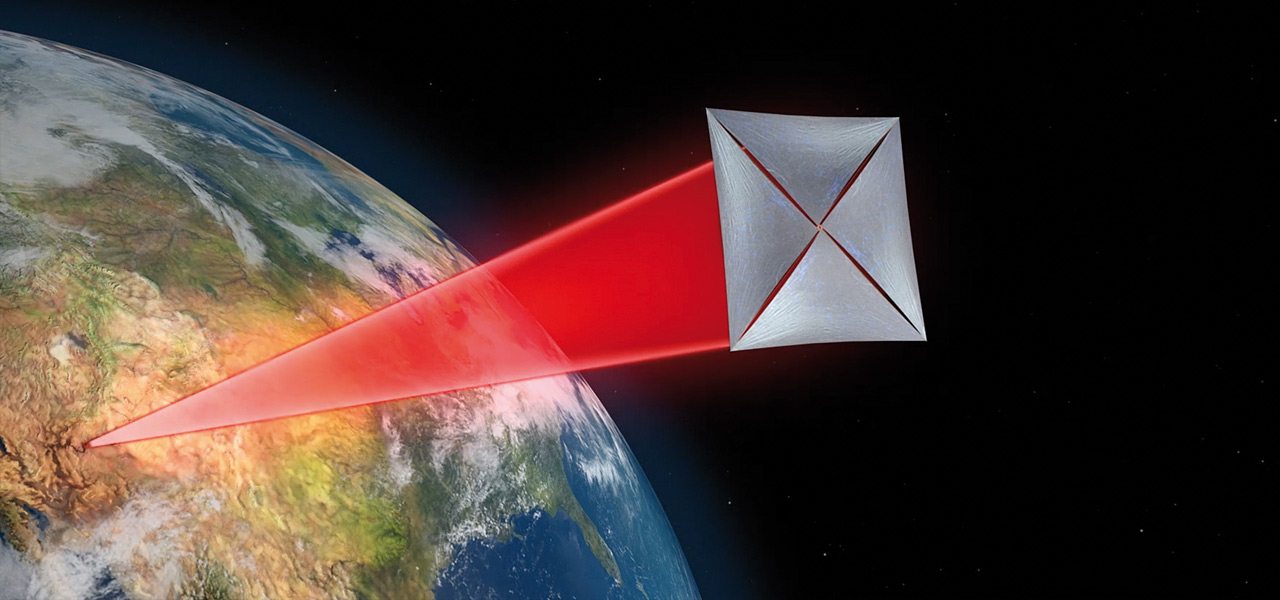
Photon sails could be propelled into space with light pressure, at least that's what the researchers of the "Breakthrough Starshot" -project are planning. Laser light will be directed onto the sails. The light pressure drives them into space. Picture: Breakthrough Starshot
As the masters of science fiction have taught us, with lasers, the sky’s the limit! And no less a luminary than the late physicist Stephen Hawking was among the initiators of an ambitious attempt to use lasers as a source of power for spacecraft. The basic idea is to focus high-intensity, earth-bound lasers on the ‘sails’ of space gliders. Although photons have no mass, they carry momentum and therefore exert radiation pressure. The photons that hit the sail are reflected and exert a force on its surface, in the same way as a ping-pong ball does when it bounces off a table-tennis bat. The essential point is not so much to save on fuel, but to accelerate very small satellites to extremely high velocities, high enough to enable them to reach and explore otherwise inaccessible regions of outer space. These examples are only a foretaste of what laser technologies may yet hold in store for us. What began as science fiction in the late 19th century has become the science of photonics in the 21st.