

Olafur Eliasson, born in Copenhagen in 1967, is one of the most influential contemporary artists, whose works fascinatingly merge science, technology, and art. The Danish-Icelandic artist, who grew up between the urban culture of Denmark and the raw nature of Iceland, deeply integrated these two worlds into his artistic practice. After studying at the Royal Danish Academy of Fine Arts in Copenhagen, he founded his studio in Berlin in 1995. Today, this studio serves as an interdisciplinary platform for collaboration among artists, architects, scientists, and technicians. Light plays a central role in Eliasson's work, which often explores the boundaries between nature and artificiality, science and emotion. His installations, including the internationally acclaimed The Weather Project (2003), challenge viewers' perceptions by presenting light not only as a physical phenomenon but also as a cultural and emotional symbol.
Boundaries between reality and illusion
"The Weather Project", presented in 2003 in the monumental Turbine Hall of the Tate Modern in London, is one of Eliasson's most impressive installations. It addresses the relationship between humans and nature and the ways we perceive environmental phenomena - especially weather. Technically precise and aesthetically overwhelming, this work uses light as a medium to blur the boundaries between reality and illusion.
The central element of The Weather Project was a massive semicircular disc reminiscent of a rising sun. This "sun" was illuminated by hundreds of high-pressure sodium (HPS) lamps, which are known for their ability to produce an intense, monochromatic yellow-orange light. The color emitted by these lamps falls at a wavelength of approximately 589 nanometers, corresponding to yellow light. This monochromatic light had a unique effect on perception: it suppressed the ability of the human eye to see other colors, reducing the visible spectrum to shades of yellow and gray. Eliasson harnessed this property to immerse the entire Turbine Hall in an otherworldly, almost dreamlike atmosphere.
Another standout feature of the installation was the enormous mirrored ceiling that spanned the entire length of the hall. This ceiling, composed of highly reflective panels, was installed with precision to create the impression that the space extended infinitely upwards. The semicircular "sun" was completed into a perfect circle through its reflection. This optical illusion heightened the perception of infinity, symbolically opening the space into another dimension. Visitors not only saw the "sun" but also their own reflections, transforming the installation into a site of introspection and self-awareness.
To enhance the visibility of the light beams and amplify the atmosphere, Eliasson used fog machines to release a mixture of water and oil particles into the air. This artificial mist altered how light was perceived, creating a dense, almost tangible structure. The particles scattered the light, rendering its physical presence visible and giving the environment a uniquely immersive quality.
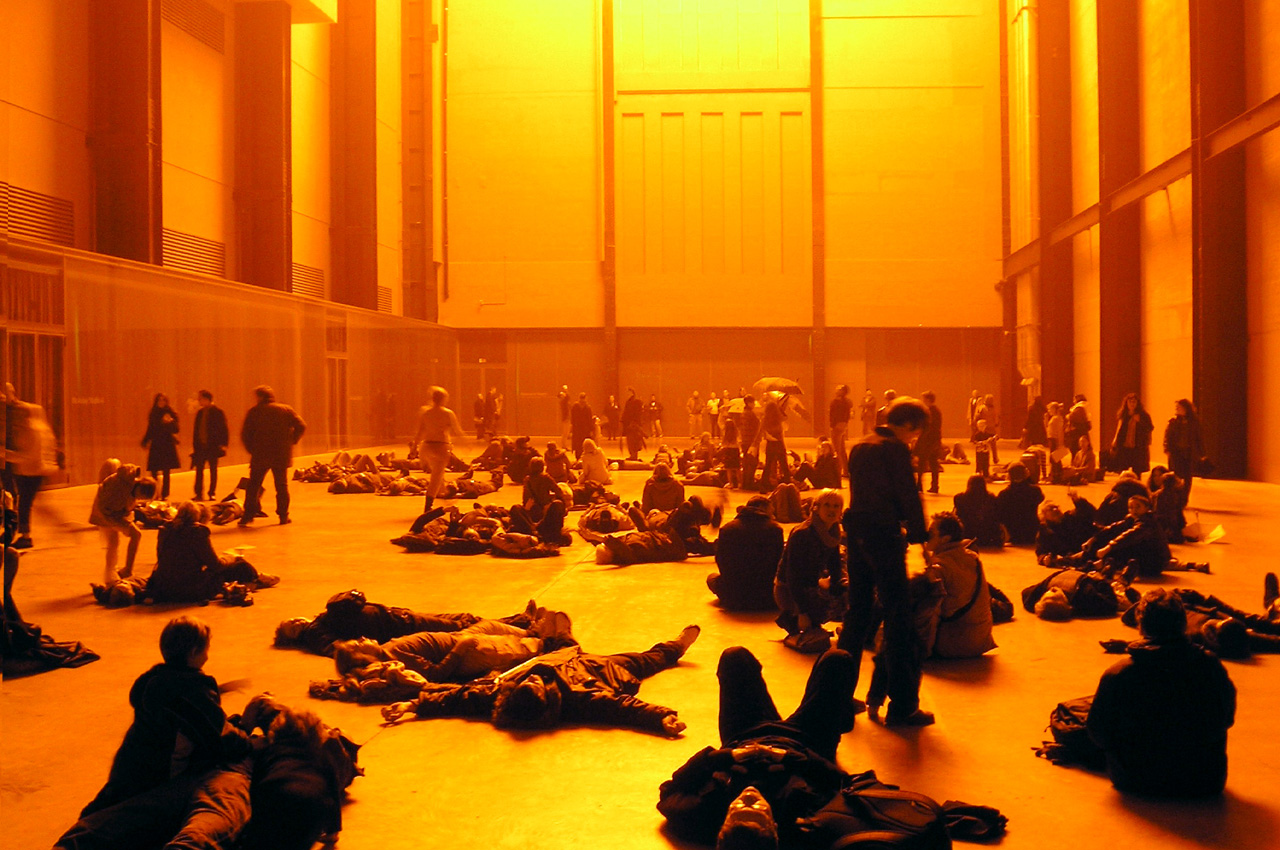
A particularly fascinating aspect of The Weather Project was the interaction between visitors and the space, shaped decisively by the monochromatic light. Photo: © User:Bjoss, Wikimedia Commons
A particularly fascinating aspect of "The Weather Project" was the interaction between visitors and the space, shaped decisively by the monochromatic light. Since the sodium lamps reduced the visible spectrum to yellow and gray tones, all individuals in the room appeared in the same hues. This subtle yet profound limitation had a deep social and aesthetic impact: distinctions in skin color, clothing, and accessories became nearly indistinguishable. The reduced color palette created a sense of equality, encouraging viewers to look beyond individual characteristics. Instead, the physical presence and interactions of people in the space came to the forefront.
Expanding tradition in an innovative way
Through this visual uniformity, visitors became part of a shared collective ensemble. This effect fostered an awareness of the collective experience of the artwork, providing space to reflect on concepts of individuality and community. Eliasson used light as a tool to temporarily dissolve social structures. In a globalized world where differences are often emphasized, he created a space of unity, inviting viewers to see themselves as equal participants in a shared experience.
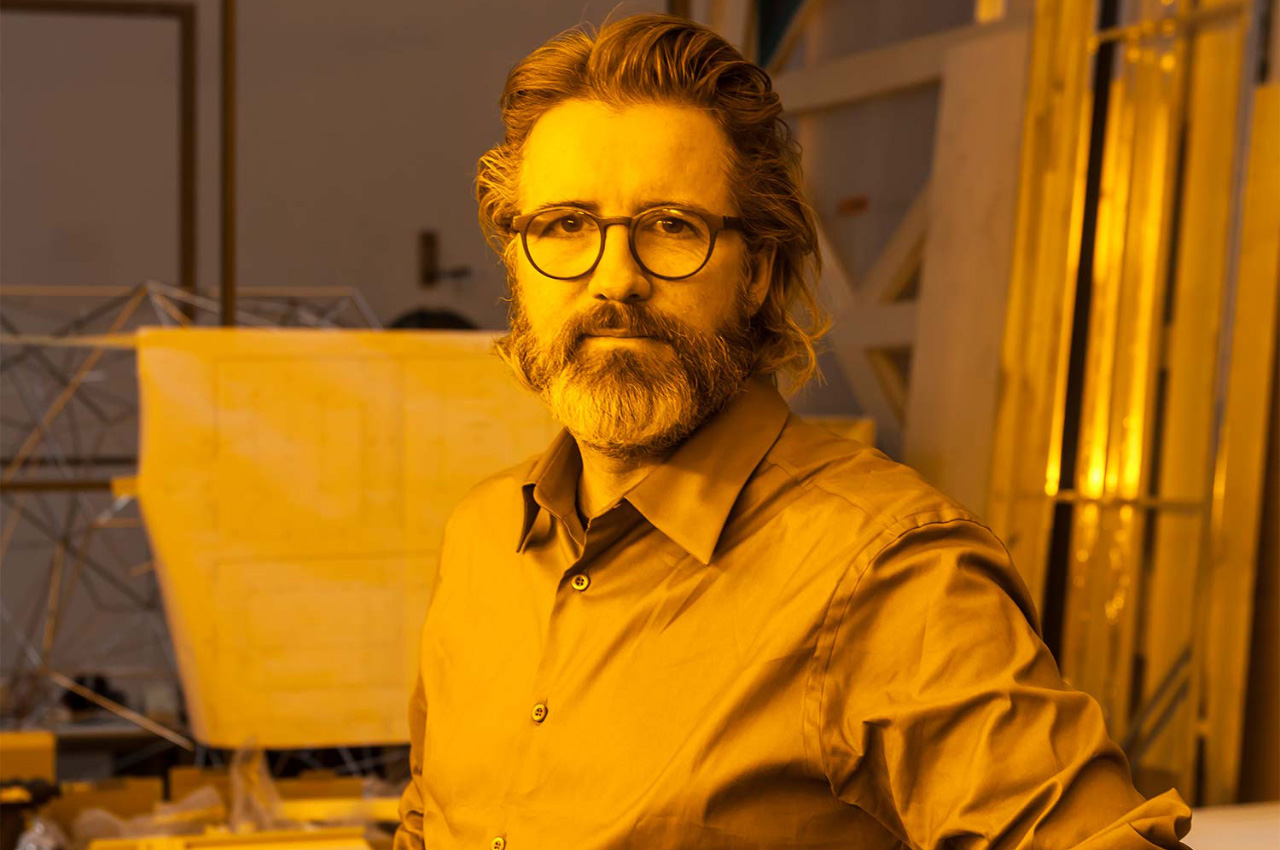
The artist Olafur Eliasson. Photo: Runa Maya Mørk Huber/Studio Olafur Eliasson © 2017 Olafur Eliasson
"The Weather Project" is a spatial installation that delves deeply into the symbolic and emotional meanings of light and weather. The sun - an archetypal symbol of life, warmth, and energy - is portrayed in a way that oscillates between artificial construction and natural experience. Eliasson explores the significance of weather as a cultural and emotional phenomenon. Weather is not merely a physical condition but also a metaphor for human moods and social dynamics. In "The Weather Project", the sun, a central symbol of weather, is artificially recreated and brought into an urban, enclosed space. This contrast between interior and exterior, nature and culture, prompts viewers to reflect on how we experience and construct nature. In an era of increasing urgency regarding climate change and environmental degradation, the artificial sun takes on an almost prophetic dimension: it serves as both a reminder of nature’s beauty and a warning of its potential destruction.
"The Weather Project" stands in a long tradition of artists using light as a medium, yet it innovatively expands and transforms this tradition. Eliasson’s work can be seen as an evolution of 20th-century light art, influenced by figures such as László Moholy-Nagy, Dan Flavin, and James Turrell. While Moholy-Nagy and Flavin primarily used light as a sculptural and kinetic element, Turrell focused on the perception of light as a spatial and physical phenomenon. Eliasson integrates these approaches, employing light as both a physical medium and a carrier of meaning and emotion. Unlike Turrell, whose works are often introspective and meditative, "The Weather Project" invites interaction and collective experience.
The depiction of weather in art has a long history, dating back to the Romantic landscape painters of the 19th century. Artists like Caspar David Friedrich and J.M.W. Turner used light and atmosphere to convey the power and beauty of nature. Eliasson updates this tradition by not only representing light but also making it physically and spatially experiential. His artificial sun serves as both an homage to Romanticism and a critical engagement with today’s relationship between humanity and the environment.
"The Weather Project" is a landmark in contemporary art, seamlessly combining technology, aesthetics, and symbolism. It challenges us to reconsider our perceptions, our relationship with nature, and how we experience community. Eliasson’s work reminds us that art is not only a visual experience but also a social and philosophical one - one capable of transforming us as individuals and as a society. This work remains a milestone in light art and an impressive example of how art can transcend the boundaries of science, technology, and emotion.