

Let's face it. Who hasn't reworked their pictures until they corresponded to their own ideas and no longer necessarily to reality? But don't worry. Anyone who has ever used filters, stamps or other tools on their photos is joining a long tradition. The subsequent editing of photographs is as old as the medium itself. This is demonstrated by the online exhibition "Image Manipulation in Photography" of the Max Planck Society's Institute of Art History. Using historical and modern methods of image manipulation, the exhibition tells the technical history of photographic retouching. It reveals how "constructed" even documentary photographs can be.
The look back to the future
The offer of social media is tantamount to an invitation to whitewash. Even before you can upload a picture, you are told that you can quickly apply a filter or two to your photo. The whole thing is then made more attractive by small preview images, which certainly have their appeal. So you start to play, to change, and thus to whitewash the truth. All of a sudden, the people in the pictures have the purest skin, the actually dreary cloudy sky becomes dramatic, or the water of a pond becomes deep blue like in the Caribbean.
With such, diplomatically expressed, "adjustments" one joins seamlessly in the long tradition of image manipulation. "The history of image manipulation is not tied to photography alone. In fact, its beginnings can already be found in prehistory and early history," explains Dagmar Keultjes, who scientifically studies the phenomenon at the Institute in Florence. "Apparently, from the very beginning, people felt the need to rework pictorial works after they were completed."
Thus, even in the early years of photography, the subsequent editing of photographs was the order of the day. The sometimes serious technical deficiencies, such as blurring or the incorrect reproduction of tonal values, had to be compensated for. This was done by corrections on the positive or directly on the negative. Soon, changes were also made in terms of content and aesthetics.
"While image manipulation can already take place through the choice of lenses or the light setting during shooting, the term retouching contains the meaning "to touch again" or just "to revise," Keultjes explains. "The focus of my dissertation was on the use of retouching in the early years of analog photography, particularly on early negatives made of paper and glass," the art historian explains. "Retouching interventions are often invisible to the viewer on the positive print, but on the corresponding negative they are still visible today as a paper mask or red contour line, as scoring or graphite powder."
In the course of the 19th century, a separate profession emerged: that of the retoucher. The techniques and tools of that time can also be found today in digital image processing. Tools such as "brush", "filter" or "masking" are directly derived from the analog retouching tools and techniques.
Back then, erasers and pencils were the tools of choice for smoothing out wrinkles or brightening shadowed areas in portraits. The portrait of a young woman shows such an intervention in reality. The pair of images comes from a manual for photo retouching from 1903. Her closed eyes were replaced by a drawn pair of eyes.
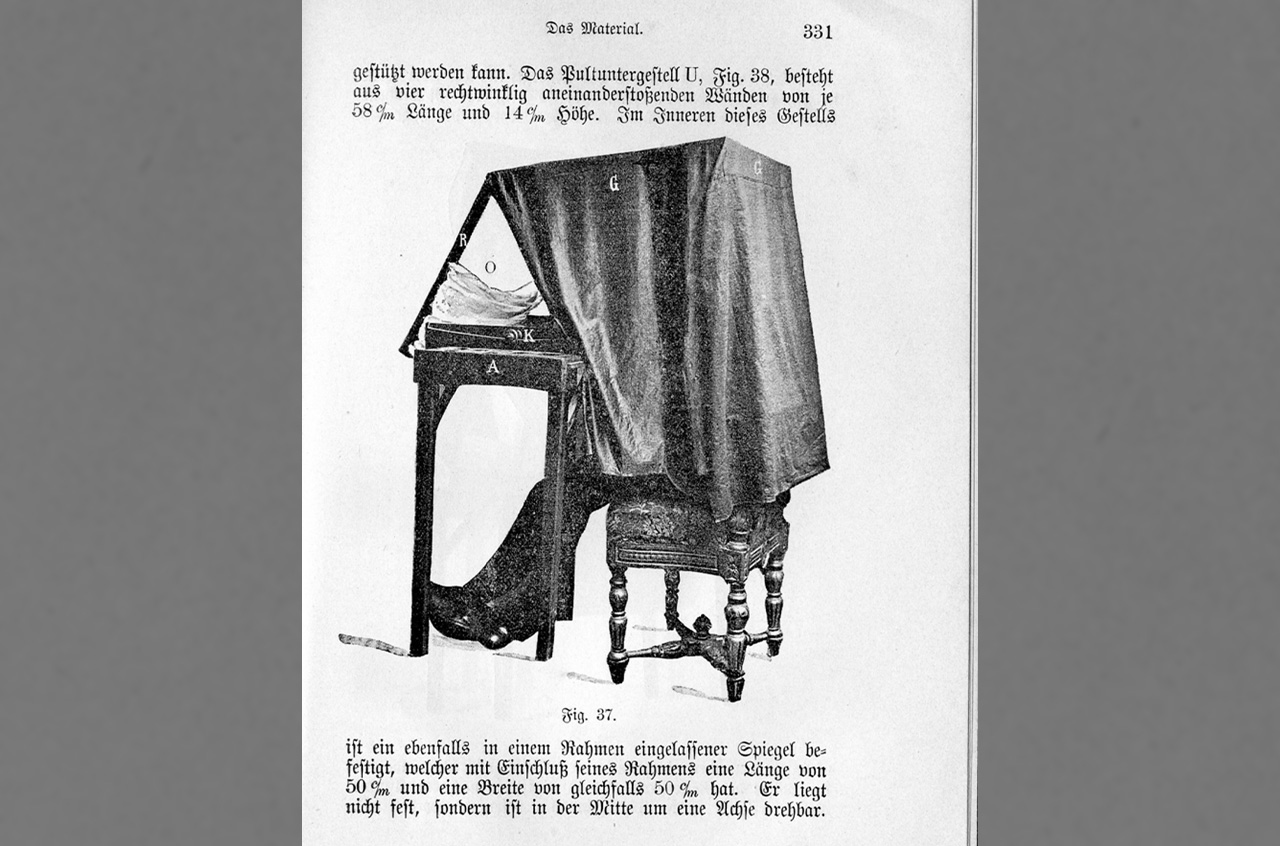
Negative retoucher at work at the retouching desk. From: Hans Arnold, Die Negativ-Retouche nach Kunst- und Naturgesetzen. With special consideration of the operations: Lighting, development, exposure and the photographic public, Vienna 1892.
Damnatio Memoriae
The most radical intervention is probably the removal of entire picture elements by cutting out, scraping off, and painting over parts of the emulsion layer on the negative. In this way, not only objects but entire people can be erased from the picture. Dagmar Keultjes explains: "During my research, I came across the removal of staffage figures in architectural and landscape photographs, as well as the targeted removal of people belonging to indigenous minorities or individuals who had fallen into political disfavor. These photographs still bear witness to discrimination and erasure today."
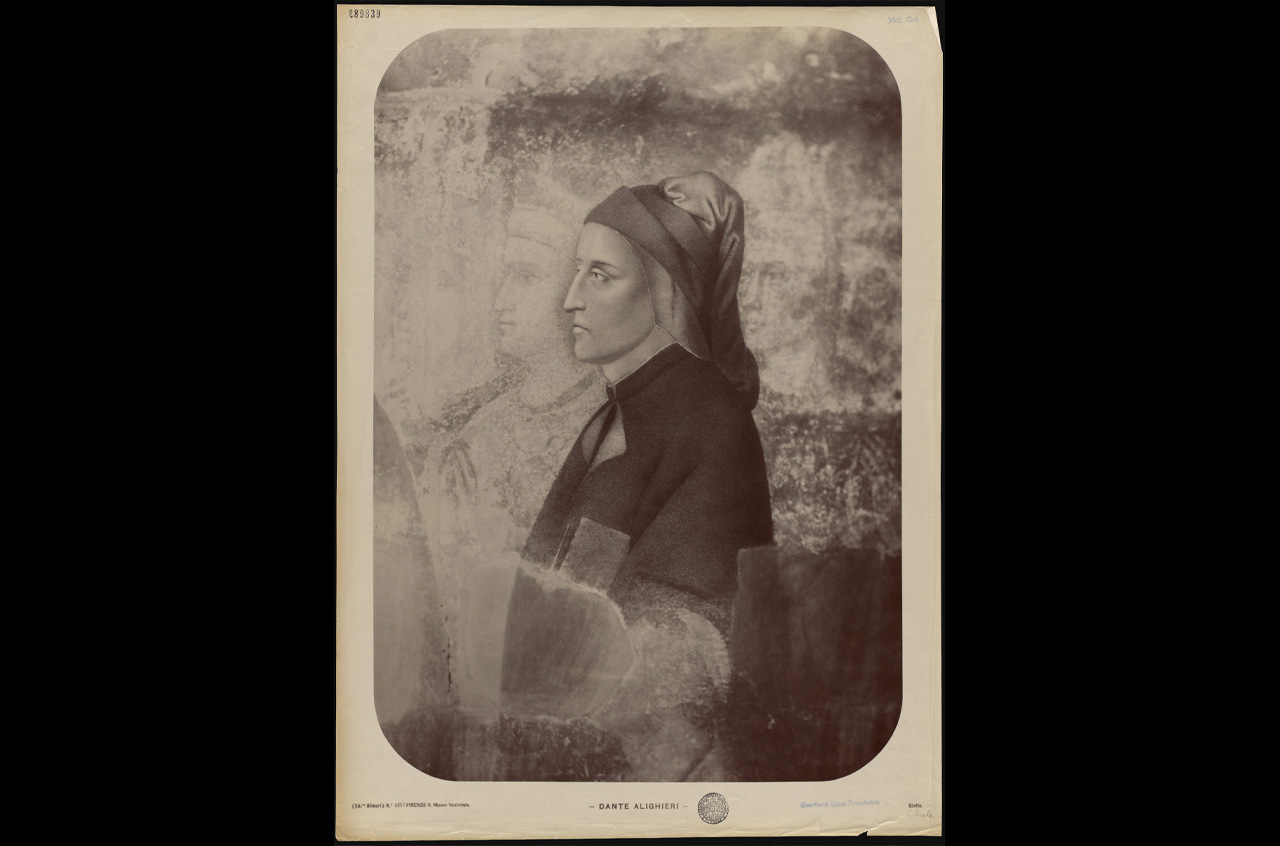
Fratelli Alinari, Porträt des Dante Alighieri, Albuminpapier, vor 1896, Photothek KHI, Inv. Nr. 289839 © Foto: Kunsthistorisches Institut in Florenz – Max-Planck-Institut
Using historical and current examples from the collection, the online exhibition of the Photothek of the Kunsthistorisches Institut in Florence presents retouching techniques. Retouching also has a firm place in art historical documentary photography, but it follows strict criteria so that its documentary character is preserved. For the subject always touches on questions about the limits of image manipulation, especially when photography is in the service of scientific documentation.
So how honest with his photos is the user who is well connected in social media? "That's a question everyone has to answer for themselves," says Dagmar Keultjes. "The possibilities of image editing are enormous." All the more exciting for the art historian is the consideration of whether we use them to create images that distort our own memories. "In his book "Cultural Memory," Jan Assmann describes the importance that pictorial works have for memory, as they symbolize ideas that are then stored in memory," says Keultjes, asking, "Aren't we exposing ourselves to a personal "visual memory disorder" when we retouch our private images? On the other hand - and this is a thoroughly positive effect - the easily accessible tools of image manipulation offer endless possibilities for creativity, especially in the private sphere."
Online exhibition:
Retouching. Image manipulation in photography
An online exhibition of the Photothek of the Art History Institute in Florence - Max Planck Institute.
Visit online at: photothek.khi.fi.it/documents/oau/00000311