

A team of scientists at CERN led by MPQ physicist Masaki Hori has found that a hybrid antimatter-matter atom behaves in an unexpected way when submerged in superfluid helium. The result may open a new way for antimatter to be used to study the properties of condensed matter, or to search for antimatter in cosmic rays.
When taking a glimpse into the shadowy world of antimatter, researchers have to rely on elaborate technical tricks to keep their samples of antimatter from coming into contact with the normal matter that surrounds us. This isolation is critically important because antimatter and matter immediately destroy each other on contact. An international team of scientists led by the Max Planck Institute of Quantum Optics (MPQ) in Garching has nevertheless combined matter and antimatter into curious hybrid atoms of helium that remain stable for short periods of time. Now the researchers from Italy, Hungary, and Germany have submerged the bizarre atoms into liquid helium and cooled it down to temperatures close to absolute zero - where the helium changes into a so-called superfluid state.
The results of the experiments carried out at the European Organization for Nuclear Research CERN in Geneva surprised the scientists because of the precise and sensitive way that the antimatter-matter hybrid atoms reacted to laser light despite the dense liquid that surrounded the atoms.
"Experiments on antimatter are particularly exciting with regards to the fundamental laws of physics," says Masaki Hori, the team leader. For example, the Standard Model of particle physics - the basis of scientists' current understanding of the structure of the universe and the forces acting within it - requires that particles and their antiparticles differ in the sign of their electric charge. An antiproton - the counterpart of the positively charged proton, a building block of atomic nuclei - carries a negative charge. According to the Standard Model the other properties are identical. "In our past experiments, we have found no evidence that the masses of protons and antiprotons differ in the slightest," notes Hori. "If any such difference could be detected, however small, it would shake the foundations of our current view of the world."
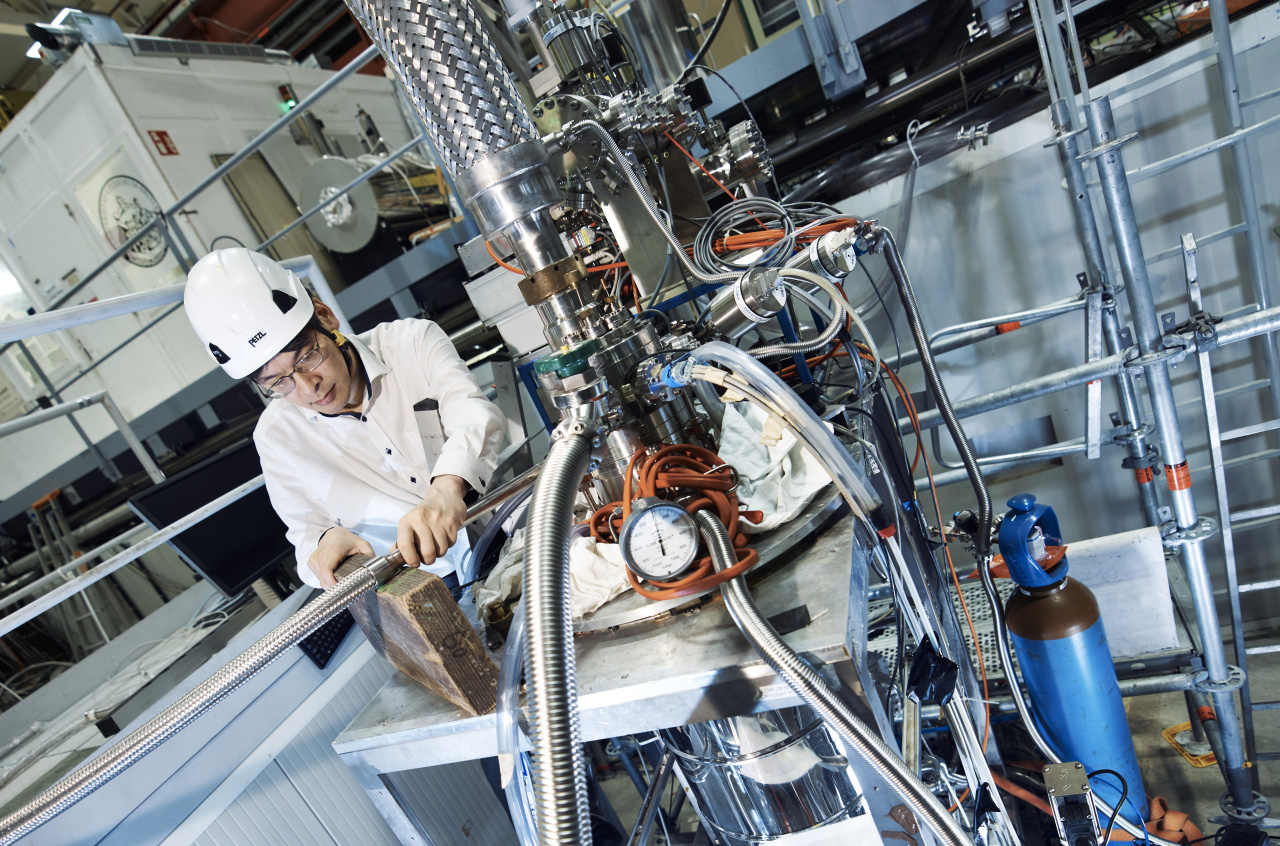
Research leader Masaki Hori at the so called ASACUSA experiment in CERN. Photo: CERN
Electron out, antiproton in
To create the exotic helium atoms containing antiprotons, the researchers used the Antiproton Decelerator at CERN - a globally unique facility that slows down the antimatter particles created in collisions of energetic protons. The slow velocity of the antiprotons makes them ideal for experiments such as those conducted by Hori's team. The researchers mixed the slow antiprotons with liquid helium cooled to a temperature of a few degrees above absolute zero, or minus 273 degrees Celsius, trapping a small part of the antiprotons in atoms of helium. The antiproton replaced one of the two electrons that normally surround a helium atomic nucleus - forming a structure that remained stable long enough to be studied spectroscopically.
"Until now, it was thought that antimatter atoms embedded in liquids could not be investigated by high resolution spectroscopy using laser beams," Hori reports. This is because the intense interactions between the densely packed atoms or molecules of the liquid lead to a strong broadening of the spectral lines. These lines are images of resonances in which the energy absorbed from the laser beam excites the atoms. They are thus a kind of fingerprint that identifies each atom. The exact position of the resonance line on the frequency scale as well as the shape reveal the properties of the atom under investigation - and the forces acting on the antiparticle. But the broadening of the lines obscures this information because it is virtually smeared. Hori and his team have now succeeded for the first time in preventing the "smearing" of the spectral lines in a liquid.
Surprisingly slim line at 2.2 Kelvin
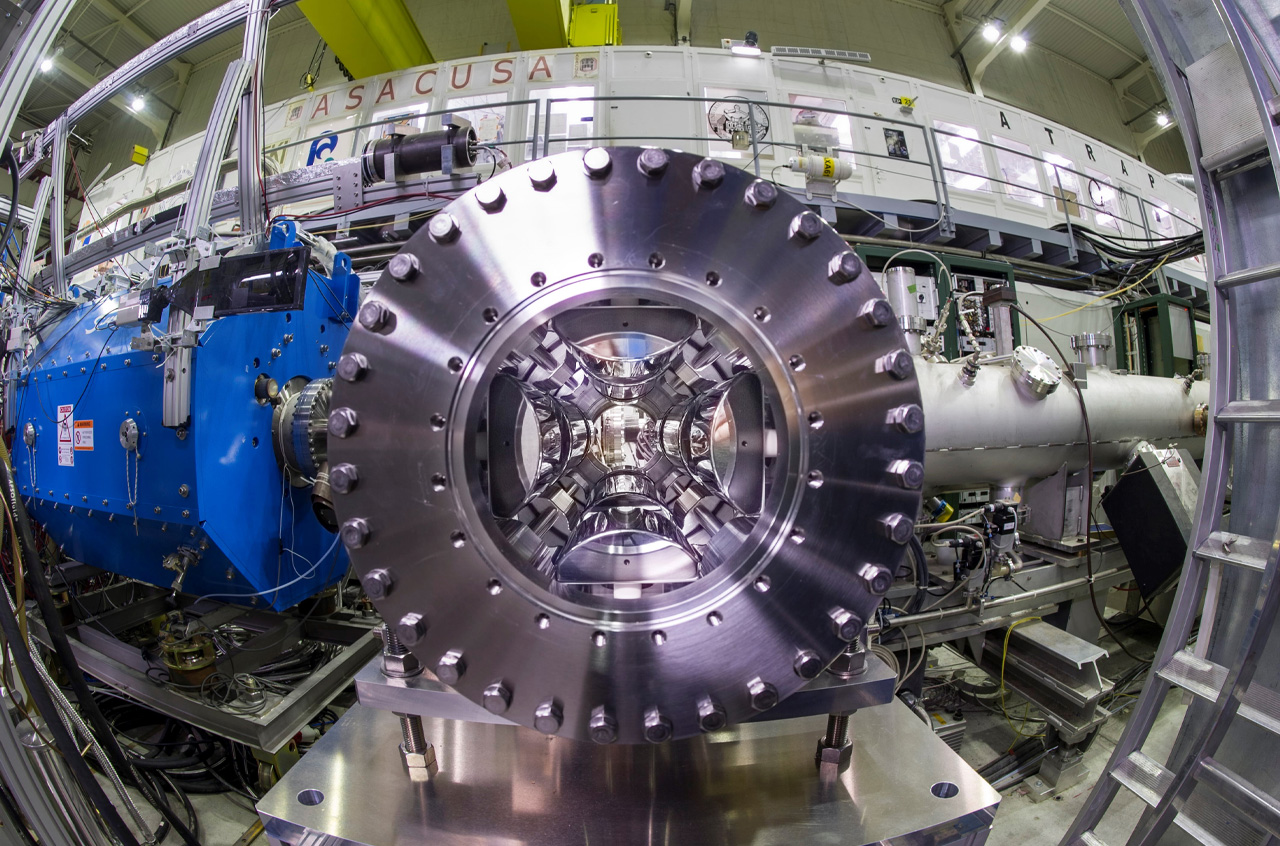
Photograph of the quadrupole triplet lens used to focus the antiproton beam into a helium target. Photo: CERN
n a series of experiments, the scientists took a spectroscopic look at the antiprotonic helium atoms at different temperatures. To do this, they irradiated the liquid helium with light from a titanium-sapphire laser, which excited two characteristic resonances of the antiprotonic atoms at two different frequencies. The surprising discovery: "If the temperature dropped below the critical temperature of 2.2 Kelvin – 2.2 degrees Celsius above absolute zero - at which helium enters a superfluid state, the shape of the spectral lines suddenly changed," reports Anna Sótér, who was the principal PhD student of the MPQ team in this project and recently promoted as assistant professor of ETH Zürich. "The lines that were very broad at higher temperatures became narrow." The superfluid phase is a special liquid state that is characterised, among other things, by the absence of internal friction. The quantum physical phenomenon is typical of helium at extremely low temperatures. "How the striking change in the spectral lines of the antiproton comes about in such an environment and what happens physically in the process is something we don't know yet," says Hori. "We were surprised by it ourselves."
But the possibilities offered by the effect are far-reaching. This is because the narrowing of the resonance lines is so drastic that when excited with light, the so-called hyperfine structure can be resolved, the scientists report in a publication in “Nature”. The hyperfine structure is a consequence of the mutual influence of the electron and the antiproton in the atom. This indicates that researchers could create in superfluid helium other hybrid helium atoms with different antimatter and exotic particles to study in detail their response to laser light and measure their masses. An example of this are pionic helium atoms that were recently studied by laser spectroscopy at the 590 megaelectron volt cyclotron facility of Paul Scherrer Institute in Villingen, Switzerland.
Searching for particles in cosmic radiation
Zudem könnten die scharfen Spektrallinien hilfreich sein beim Nachweis von Antiprotonen und Antideuteronen in der kosmischen Strahlung. Ihnen sind ForscherInnen bereits seit Jahren auf der Spur, etwa mit Experimenten an Bord der Internationalen Raumstation ISS. Demnächst werden Wissenschaftler auch einen Testballon über der Antarktis starten – mit einem Instrument an Bord, das Antiprotonen und Antideuteronen aufspüren kann, die möglicherweise in sehr großen Höhen in der Atmosphäre existieren. Masaki Hori spekuliert: „Detektoren mit superfluidem Helium könnten solche Versuche unterstützen und wären geeignet, Antiteilchen aus dem All einzufangen und zu analysieren.“ Das würde womöglich zur Lösung eines anderen großen Rätsels beitragen: der Frage nach dem Wesen der Dunklen Materie – einer ominösen und bislang unbekannten Materieform, die nicht sichtbar ist, aber offenbar einen Großteil der Masse im Universum ausmacht. In einigen Theorien wird angenommen, dass bei der Wechselwirkung Dunkler Materie im Halo unserer Galaxie Antiteilchen entstehen, die dann zur Erde gelangen können. Ausgerechnet Antimaterie könnte so Licht in dieses Dunkel bringen.
Original publication:
Sótér, A., Aghai-Khozani, H., Barna, D. et al.
High-resolution laser resonances of antiprotonic helium in superfluid 4He
Nature (2022)