

Astroparticle physicist Dr. Nils Haag followed the launch of the James Webb Telescope into space with great excitement. Today, Haag may be working in laser physics, on the attoworld team at Ludwig Maximilian University, but the vastness of space still excites him. He is looking forward to the new discoveries that the telescope will enable his former colleagues around the world to make.
From Hubble to James Webb
Since time immemorial, space has irresistibly captivated us. Its sheer unimaginable size, home to some one hundred billion galaxies with countless stars and alien planets, leaves as much to our imagination as it does to scientific discovery.
When the Hubble Telescope was launched in April 1990, I was just seven years old and had no idea how much this instrument would impact me. The older I got, the more images from Hubble I got my hands on, the more my fascination for the vastness of space grew.
Today, Hubble stands for a scientific showcase instrument whose incomparable images have managed to bring the enthusiasm of physicists for their research to the public - and to produce one or the other amateur or professional astronomer. In addition to enjoying the wonderful images, I am always amazed at how much we can learn just by looking at how much light comes from which direction and with which color. That alone teaches us an enormous amount about the origins, structure, objects and physics of our universe.
More than 30 years later, I am now sitting in my office under a photograph with a stunning Hubble Deep Field image, tracking mission data from the James Webb Space Telescope (JWST), the scientific successor to the Hubble Telescope.
After being sent on its way in late December on an Ariane 5 rocket at a maximum speed of 10 kilometers per second, the JWST reached its deployment site 1.5 million kilometers away a few days ago. There, it can remain for well over 10 years with minimal fuel consumption and free of background noise. But even on the flight there, which took about a month, the telescope was able to reach some important milestones of the mission.
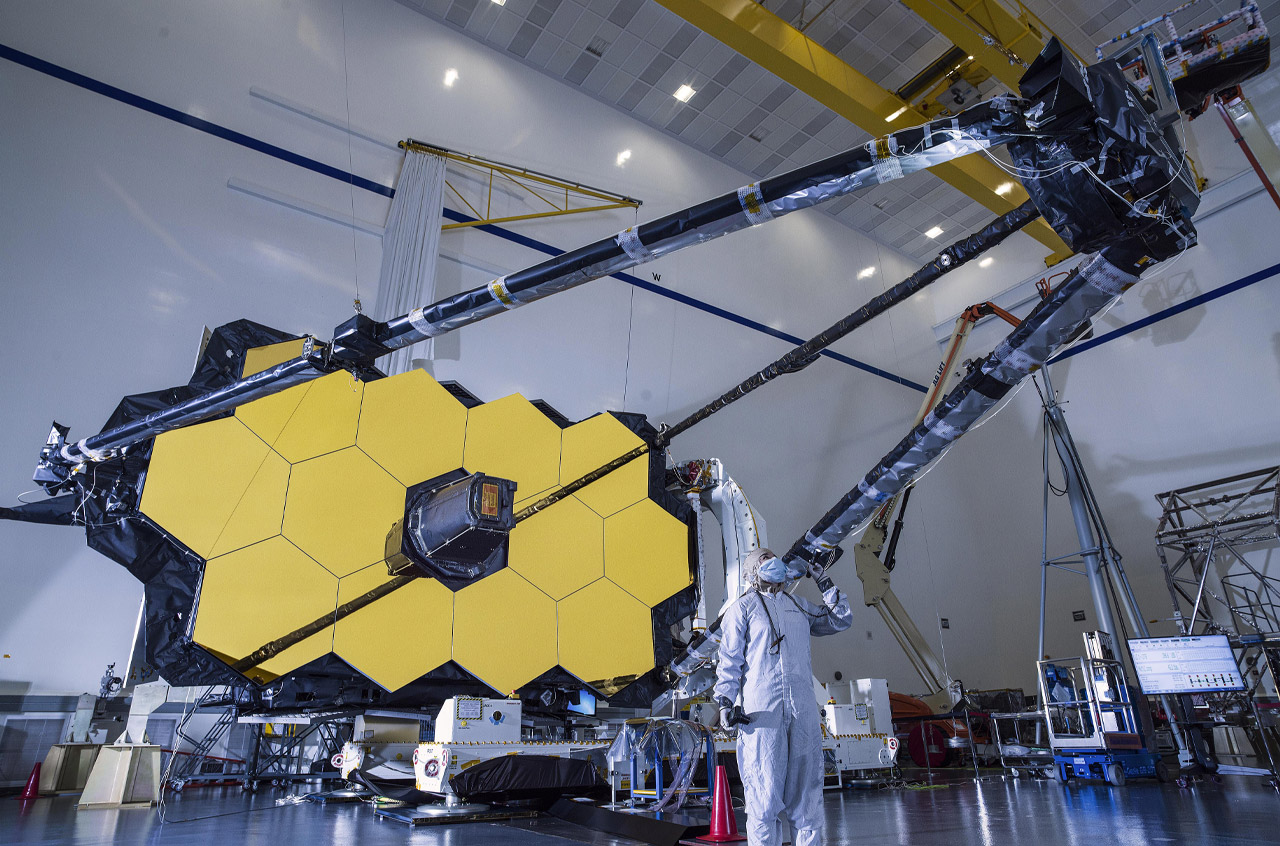
To leave nothing to chance, the telescope went through an extensive test program. The photo shows an unfolding test. Photo: NASA / Chris Gunn
For first, the telescope had to unfold. The JWST's mirror is so large (6.5 m in diameter) that it is composed of 18 smaller, hexagonal elements rather than a single piece. To fit inside the rocket, some of these segments had to be folded in and could not be moved to their measurement position until the telescope was separated from the rocket. Each of these segments is controlled by its own motors and can be individually adjusted in height and angle. Even the curvature of the mirrors can be changed in this way. This means that corrections can still be made afterwards, since a maintenance mission is impossible due to the enormous distance from Earth.
"Mail" from space
The multi-layered sun shield, which is about the size of a tennis court, has also been successfully deployed. It ensures that the sensitive instruments, which operate at temperatures well below -200 °C, are not disturbed by the sun's thermal radiation, which heats the side of the shield facing it to about 80°C.
Indeed, the James Webb telescope specializes precisely in measuring infrared radiation, or thermal radiation. It is designed to take pictures of the first luminous objects in the universe and give us new insights into the formation of galaxies, stars, black holes and planets. However, because the universe has continued to expand since that time, all light is redshifted. This means that even visible light at that time now has wavelengths that can only be observed with infrared telescopes. The James Webb telescope can look about 13.5 billion years into the past because of its unprecedented sensitivity.
When one receives a letter, the message has already been written and sent a few days ago. One receives therefore information which corresponds to a state from the past. It is the same with the light from the early time of the universe. It was sent out billions of years ago, but because of the long travel time it arrives today only with us.
In addition, the JWST will be able to study exoplanets and determine the composition of their atmospheres through infrared spectroscopy. Perhaps in this way it will contribute to finding traces of extraterrestrial life, or at least planets on which life may arise.
But even after reaching its observation post, the telescope still has a few months to go before the first images reach us. For example, all the instruments will have to cool down to operating temperature and the mirrors and instruments will have to be adjusted and calibrated. Around the beginning of summer, the JWST will begin to probe the depths of space. And maybe one day my sons will develop the same passion through these images of the James Webb Telescope that Hubble once awakened in me.