
Light for Mating and Defense
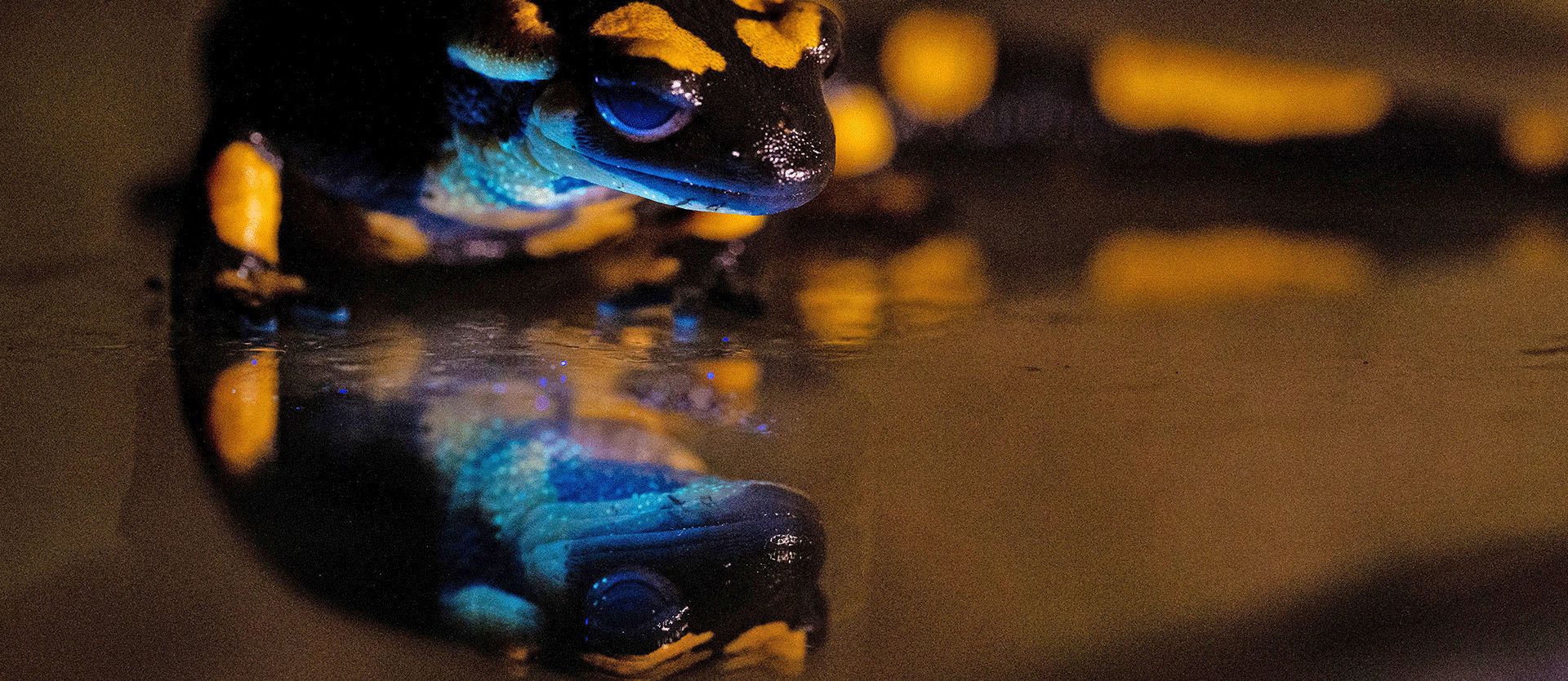
 ven in daylight, it is a beautiful animal, instantly recognizable by its distinctive black-and-yellow pattern. Yet the fire salamander also knows how to stand out after dark. Under ultraviolet light, the amphibian displays characteristic fluorescent patterns. Its underside and flanks emit a bright turquoise-blue glow. This remarkable phenomenon has now been discovered by an international research team led by scientists from the Natural History Museum of Barcelona.
The fire salamander (Salamandra salamandra) is biofluorescent. Substances in the animal’s blood and granular glands also glow under ultraviolet light, suggesting a systemic distribution of fluorescent molecules—a rare trait previously known only from certain tree frog species.
The discovery was made by researchers from the Natural History Museum of Barcelona, the Institute of Evolutionary Biology of the Spanish National Research Council, Pompeu Fabra University in Barcelona, and the Max Planck Institute for Chemical Ecology in Jena, Germany.
The study shows that biofluorescence is concentrated primarily on the salamander’s yellow underside and body flanks. The effect is produced by skin glands and their secretions, which retain their fluorescent properties for more than 24 hours after being released.
“It is fascinating that such a well-studied species still harbors previously unknown phenomena. This reminds us that even familiar organisms can conceal secrets that only become apparent when investigated using new methods,” says Bernat Burriel, researcher at the Natural History Museum of Barcelona and first author of the study.
When ultraviolet light, which is invisible to the human eye, strikes the salamander’s skin, chemical compounds within the tissue absorb the radiation and re-emit it at visible wavelengths. This creates a striking coloration in green and cyan tones. The phenomenon is known as biofluorescence and differs from bioluminescence in that it depends on an external light source. Bioluminescent organisms, such as fireflies, generate light independently through chemical reactions.
For a long time, biofluorescence was thought to be restricted to marine environments. However, recent discoveries have revealed that it is also widespread in terrestrial habitats. The findings suggest that biofluorescence may serve important biological functions. For example, it could facilitate communication between salamanders, influence mate choice, or enhance warning signals directed at potential predators.
“The fluorescence fulfills several criteria that point to a communicative function. It may help salamanders detect one another at night or in particularly dense habitats, or it may serve as an additional warning signal against predators,” says Martin Kaltenpoth, Head of the Department of Insect Symbiosis at the Max Planck Institute for Chemical Ecology and co-author of the study.
The precise function of fluorescence in fire salamanders remains unclear. Visually oriented animals with highly sensitive vision may be able to perceive this cyan-green fluorescence even at very low intensities. Humans, by contrast, can only detect it with the aid of a UV lamp. In a forest at night, the only light reaching the ground where salamanders live comes from the moon and stars. Moonlight contains a higher proportion of ultraviolet and violet wavelengths than daylight. Salamanders may therefore increase their visibility to conspecifics by adding cyan-green highlights to their yellow skin.
The salamanders’ natural fluorescence may also form part of a warning strategy. Many animals use conspicuous coloration to signal their toxicity or unpalatability to predators.
Exactly which chemical compounds are responsible for the biofluorescence remains unknown.
“We do not yet know which compound is responsible for this fluorescence. All evidence suggests that it is a molecule that has not previously been identified in this species. Identifying it will be crucial for understanding both its origin and its function,” adds Salvador Carranza, researcher at the Institute of Evolutionary Biology at Pompeu Fabra University and co-author of the study.
The team is currently working to chemically characterize the candidate compounds.
Original publication:
Burriel-Carranza et al.
Glandular biofluorescence in fire salamanders (Salamandra salamandra): first evidence and ecological implications.
Royal Society Open Science 13: 251991.

Welcome to Photonworld – a platform for knowledge, interesting facts and science on the topic of light. Photonworld aims to provide a basic understanding of the physics of light and its countless phenomena. From medicine, to art and physics: all topics are covered.
Photonworld originated as an initiative of the excellence cluster the Munich-Centre for Advanced Photonics (MAP) and the Laboratory for Attosecond Physics (LAP) at the Max Planck Institute of Quantum Optics (MPQ).


The initiator of the project is Prof. Dr. Ferenc Krausz, Chair of Experimental Physics at the LMU and Director of the MPQ.
Photonworld’s Student Zone reports directly out of the PhotonLab, which is supported by the Munich Center for Quantum Science and Technology (MCQST) and the DFG Research Unit FOR 2783. At the PhotonLab, schoolteachers and students can find up-to-date information about experiments and goings-on at the lab, and plan their own visit to the laboratory.