
Let there be light in the computer
 ill we one day compute with light? Researchers at the University of Oldenburg have taken a small step closer to this long-held dream of electronics. Together with colleagues from Cambridge, Berlin, and Milan, they have discovered an ultrafast switching process that can be controlled using laser light. This mechanism is roughly 1,000 times faster than conventional transistors. However, an unwanted side effect could complicate practical implementation.
Billions of them are hidden inside our laptops and smartphones: transistors, the fundamental pillars of modern electronics. These tiny switches translate electrical voltage and currents into zeros and ones – the binary language of the digital world, through which all computing processes are carried out.
Yet these switches have a fundamental weakness: they operate using electrons. These interact with the material, which slows them down and causes energy losses in the form of heat.
For decades, scientists have dreamed of an alternative: an optical computer that relies on light instead of electrons. Light travels at the highest speed in the universe – and it interacts very little with matter. It would therefore be ideal for fast and energy-efficient computing processes.
But how do you switch with light? One possible answer may lie in polariton – hybrid particles that are simultaneously made of light and matter. They form when the two components interact so strongly that they practically merge and adopt a shared identity.
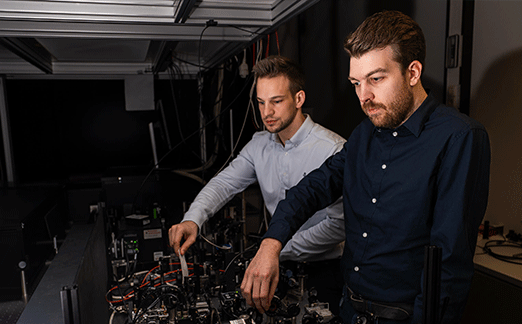
Moritz Gittinger (left) and Daniel Timmer carried out the experiments in the laboratory. Photo: Moritz Gittinger
Researchers at the University of Oldenburg have now observed an effect in polaritons within a newly developed material that can be controlled using extremely short light pulses. The study demonstrates the great potential of polaritons as ultrafast optical switches – while also highlighting that this endeavor is more complex than previously assumed. The team also discovered a process that delays switching by several orders of magnitude. The results were recently published in the scientific journal 'Nature Nanotechnology' and stem from a collaboration with the University of Cambridge, Politecnico di Milano, and TU Berlin.
The material developed by the researchers consists of two layers: a thin semiconductor layer made of tungsten disulfide, just one atom thick. Under normal conditions, light would pass through this layer almost undisturbed. This is where the second layer comes into play. It is made of silver and features tiny slits, about a thousand times thinner than a human hair. In this special structure, polaritons can form under the right conditions.
When light hits the slits at a specific angle, it is guided along the surface in the form of a wave – similar to a water wave. These surface waves of light are known as "plasmons." At the same time, the light excites the semiconductor material: electrons are freed from atoms, creating so-called "excitons", pairs of negatively charged electrons and positively charged holes. An ongoing exchange of energy then begins between plasmons and excitons, causing them to merge into polaritons.
Precisely this energy exchange process was what the researchers wanted to investigate in detail. To do so, they employed an elaborate measurement technique involving two ultrashort laser pulses to precisely excite the sample. A third, extremely short laser pulse captures a "snapshot" of the event. This allows quantum processes to be recorded like a movie with very high temporal resolution.
The scientists made a remarkable discovery: the laser light influences the energy exchange between plasmons and excitons – and this, in turn, significantly alters the optical properties of the material. By exciting the sample with the laser pulse, the reflectivity of the material can be changed by about 10 percent. This effect can be generated within just a few femtoseconds and is thus roughly 1,000 times faster than typical switching processes in an electronic transistor.
"Each material on its own would show no or only a minimal switching effect," explains Professor Christoph Lienau, who leads the research group in Oldenburg. "But together, they produce a significant effect."
However, the researchers also observed an unwanted side effect. For fast switching, the system altered by the laser must rapidly return to its original state, determined by the lifetime of the polaritons. Yet the measurements show that part of the polaritons decay within a very short time into so-called "dark states," which do not interact with the laser light. In these dark states, the material remains for about 100 times longer than the actual switching process, effectively putting the switch into a kind of deep sleep. "The dark states thus store energy in the system for longer, which we naturally want to avoid for fast switching," says Daniel Timmer, the study's first author.
In the future, the researchers aim to learn even more about the interactions within polaritons – and to further explore how these could be used for light-based switching. A crucial step in this direction would be suppressing the dark states.
To achieve this, the scientists are working on multiple fronts. On one hand, they are refining the existing sample design. On the other hand, they are pursuing a different approach: microcavities. Here, the semiconductor sample is not combined with a silver layer but placed between two mirrors. "This could significantly extend the lifetime of the polaritons, suppress dark states, and greatly enhance the sensitivity of the switching process," says Christoph Lienau.
Original publication:
Timmer, D., Gittinger, M., Quenzel, T. et al.
Ultrafast transition from coherent to incoherent polariton nonlinearities in a hybrid 1L-WS2/plasmon structure
Nat. Nanotechnol. 21, 216–222 (2026)
doi.org/10.1038/s41565-025-02054-4

Welcome to Photonworld – a platform for knowledge, interesting facts and science on the topic of light. Photonworld aims to provide a basic understanding of the physics of light and its countless phenomena. From medicine, to art and physics: all topics are covered.
Photonworld originated as an initiative of the excellence cluster the Munich-Centre for Advanced Photonics (MAP) and the Laboratory for Attosecond Physics (LAP) at the Max Planck Institute of Quantum Optics (MPQ).


The initiator of the project is Prof. Dr. Ferenc Krausz, Chair of Experimental Physics at the LMU and Director of the MPQ.
Photonworld’s Student Zone reports directly out of the PhotonLab, which is supported by the Munich Center for Quantum Science and Technology (MCQST) and the DFG Research Unit FOR 2783. At the PhotonLab, schoolteachers and students can find up-to-date information about experiments and goings-on at the lab, and plan their own visit to the laboratory.