
Up close to the Sun
 ew images from the world’s largest solar telescope show the Sun’s surface in unprecedented detail. For the first time, they reveal tiny plasma vortices on the surface of our star. These vortices may help explain why the outermost atmosphere of stars like the Sun is many times hotter than their visible surface. Researchers have published the discovery in the journal Nature.
For decades, the Sun has posed a major mystery to scientists: Why is its outermost atmosphere—the so-called “corona”—millions of degrees hot, while its visible surface is significantly cooler at “only” about 5,500 degrees Celsius?
An international team of researchers from the Max Planck Institute for Solar System Research, the U.S. National Solar Observatory, and the U.S. High Altitude Observatory has now come a step closer to solving this mystery. Using the world’s largest solar telescope—the Daniel K. Inouye Solar Telescope in Hawaii—along with sophisticated computer simulations, the researchers have succeeded for the first time in visualizing tiny plasma vortices on the Sun’s surface.

The new images were taken using the Daniel K. Inouye Solar Telescope on the island of Maui in the U.S. state of Hawaii. Photo Credit: NSF/NSO/AURA
To do so, they had to resolve structures about 20 kilometers in size on the Sun’s surface. “That is at the limit of what even the world’s largest solar telescope and state-of-the-art simulations can achieve,” explains co-author Michiel van Noort of the Max Planck Institute for Solar System Research in Göttingen. The Sun is about 150 million kilometers away from Earth. Achieving this level of resolution is akin to trying to make out a one-euro coin from a distance of 180 kilometers.
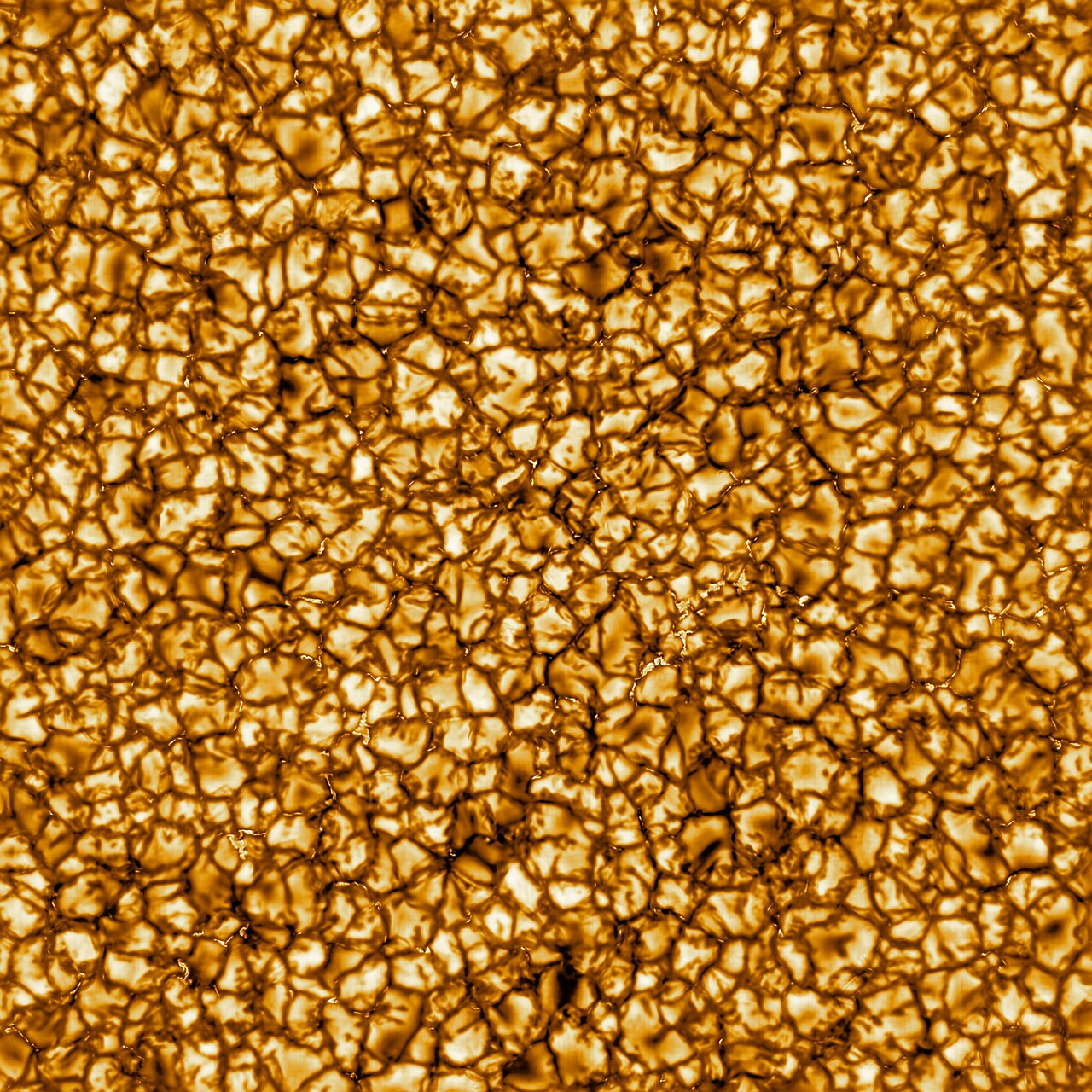
The granulation on the Sun's surface resembles boiling water in a pot. The image was taken in 2020 and was also captured by the Daniel K. Inouye Solar Telescope. Photo Credit: NSO/AURA/NSF, CC BY 4.0, via Wikimedia Commons
The newly discovered vortices occur at the edges between so-called granules, which cover the Sun’s visible surface. These structures—ranging in size from about 500 to 2,000 kilometers—are formed by hot plasma rising from the Sun’s interior, which cools at the surface and sinks back down. Viewed from a distance, they form a pattern reminiscent of boiling water in a pot.
Behind the newly discovered vortices at the edges of the granules, the researchers suspect a well-known effect from fluid dynamics: the so-called Kelvin–Helmholtz instabilities. These occur when two fluids—liquids or gases—flow past each other at different speeds. Due to shear forces that arise at the interface, even the smallest disturbances can grow into wave- or vortex-like flows. The effect is ubiquitous: it occurs, for example, on the surface of lakes, in ocean waves, during cloud formation, or in the atmospheres of the gas giants Jupiter and Saturn.
The new images and computer simulations show that there appear to be regions even at the edges of solar granules where adjacent layers of plasma flow at different speeds. This process could potentially contribute to the heating of the Sun’s outermost atmosphere—a possible key to the mystery of the hot corona. In addition, the plasma vortices could expand our understanding of how the Sun stores and releases energy in its magnetic field—for example, during solar flares.
“The newly discovered plasma vortices impressively demonstrate how minute processes — at the limit of what we can resolve using all available techniques — significantly determine the nature of our star.,” summarizes Sami K. Solanki, director at the Max Planck Institute for Solar System Research.
Original publication:
Kuridze, D., Wöger, F., van Noort, M. et al.
Ubiquitous Kelvin–Helmholtz instabilities driving plasma mixing on the Sun
Nature (2026)
doi.org/10.1038/s41586-026-10871-3

Welcome to Photonworld – a platform for knowledge, interesting facts and science on the topic of light. Photonworld aims to provide a basic understanding of the physics of light and its countless phenomena. From medicine, to art and physics: all topics are covered.
Photonworld originated as an initiative of the excellence cluster the Munich-Centre for Advanced Photonics (MAP) and the Laboratory for Attosecond Physics (LAP) at the Max Planck Institute of Quantum Optics (MPQ).


The initiator of the project is Prof. Dr. Ferenc Krausz, Chair of Experimental Physics at the LMU and Director of the MPQ.
Photonworld’s Student Zone reports directly out of the PhotonLab, which is supported by the Munich Center for Quantum Science and Technology (MCQST) and the DFG Research Unit FOR 2783. At the PhotonLab, schoolteachers and students can find up-to-date information about experiments and goings-on at the lab, and plan their own visit to the laboratory.