
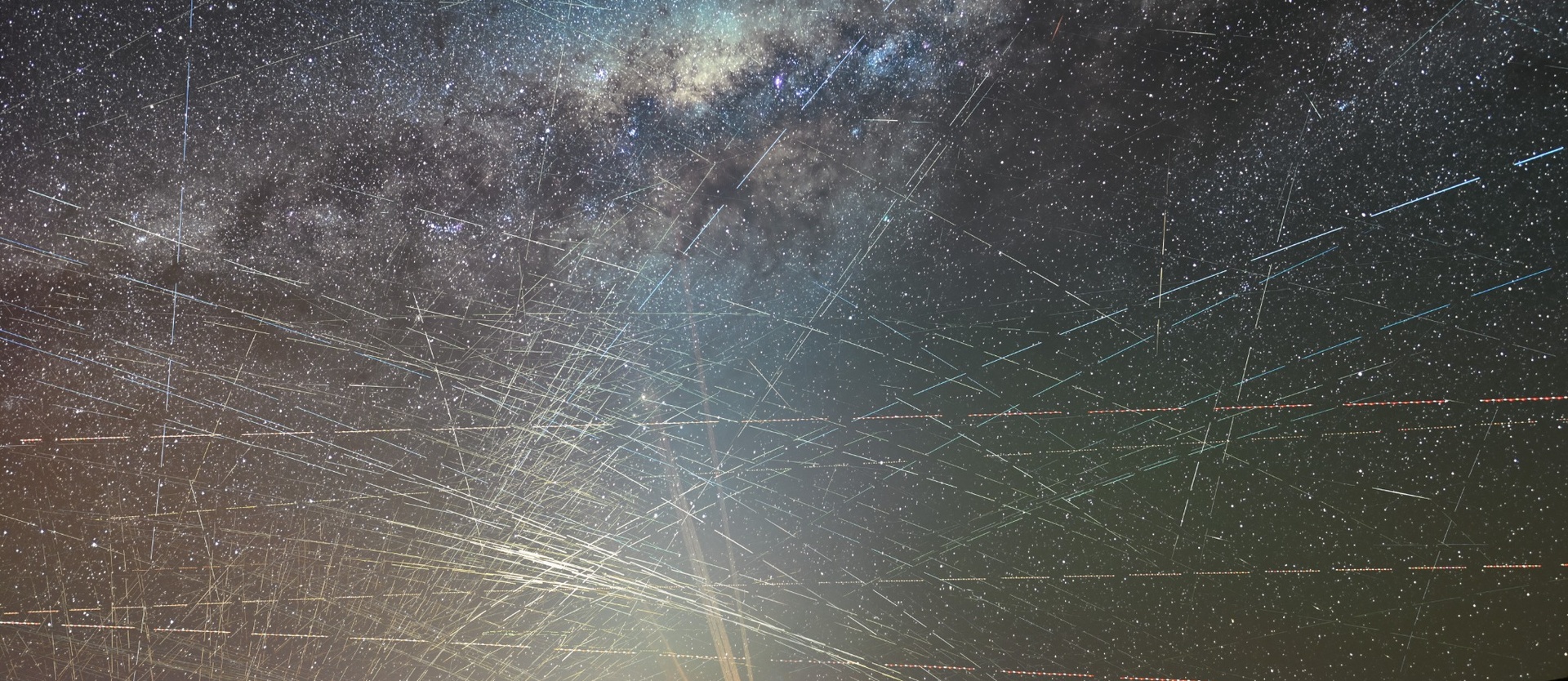
Bright Night
 he night sky is no longer truly dark. A newly released image by the European Southern Observatory (ESO) illustrates this strikingly. It shows satellites crossing the night sky above the northern Atacama Desert in Chile within the span of just one hour. The image was created from a sequence of frames taken from a time-lapse video recorded in October 2025, around two hours after sunset. Some of the streaks were left by aircraft and can easily be identified by their flashing coloured lights. Most of the trails, however, were produced by satellites. In the foreground stands the dome of ESO’s Extremely Large Telescope (ELT).
A new ESO study has found that current plans to launch more than 1.7 million satellites into orbit over the coming years would have devastating consequences for astronomy. According to the study, no more than 100,000 faint satellites visible to the naked eye should orbit Earth. Keeping satellite numbers below this threshold would preserve astronomers’ ability to observe the night sky with modern telescopes.
Since 2019, the number of satellites orbiting Earth has increased dramatically and now exceeds 14,000. A significant share of these are SpaceX’s Starlink telecommunications satellites. Although companies such as SpaceX have taken steps to reduce the brightness of their satellites, the authors conclude that the planned satellite constellations far exceed what can be tolerated if high-quality astronomical observations are to remain possible.
Original publication:
O. R. Hainaut, “Large or bright satellite constellations Effects on observations, including on the background sky brightness”, Astronomy & Astrophysics (2026)

Welcome to Photonworld – a platform for knowledge, interesting facts and science on the topic of light. Photonworld aims to provide a basic understanding of the physics of light and its countless phenomena. From medicine, to art and physics: all topics are covered.
Photonworld originated as an initiative of the excellence cluster the Munich-Centre for Advanced Photonics (MAP) and the Laboratory for Attosecond Physics (LAP) at the Max Planck Institute of Quantum Optics (MPQ).


The initiator of the project is Prof. Dr. Ferenc Krausz, Chair of Experimental Physics at the LMU and Director of the MPQ.
Photonworld’s Student Zone reports directly out of the PhotonLab, which is supported by the Munich Center for Quantum Science and Technology (MCQST) and the DFG Research Unit FOR 2783. At the PhotonLab, schoolteachers and students can find up-to-date information about experiments and goings-on at the lab, and plan their own visit to the laboratory.